Badacey rules: score the five-card low and the Badugi half
A wheel can win only half the pot. A paired hand can win the other half. Badacey makes both statements possible because the same five cards are evaluated twice: once as an ace-to-five low and once for their best Badugi selection. Get those two results onto separate lines before moving any chips.
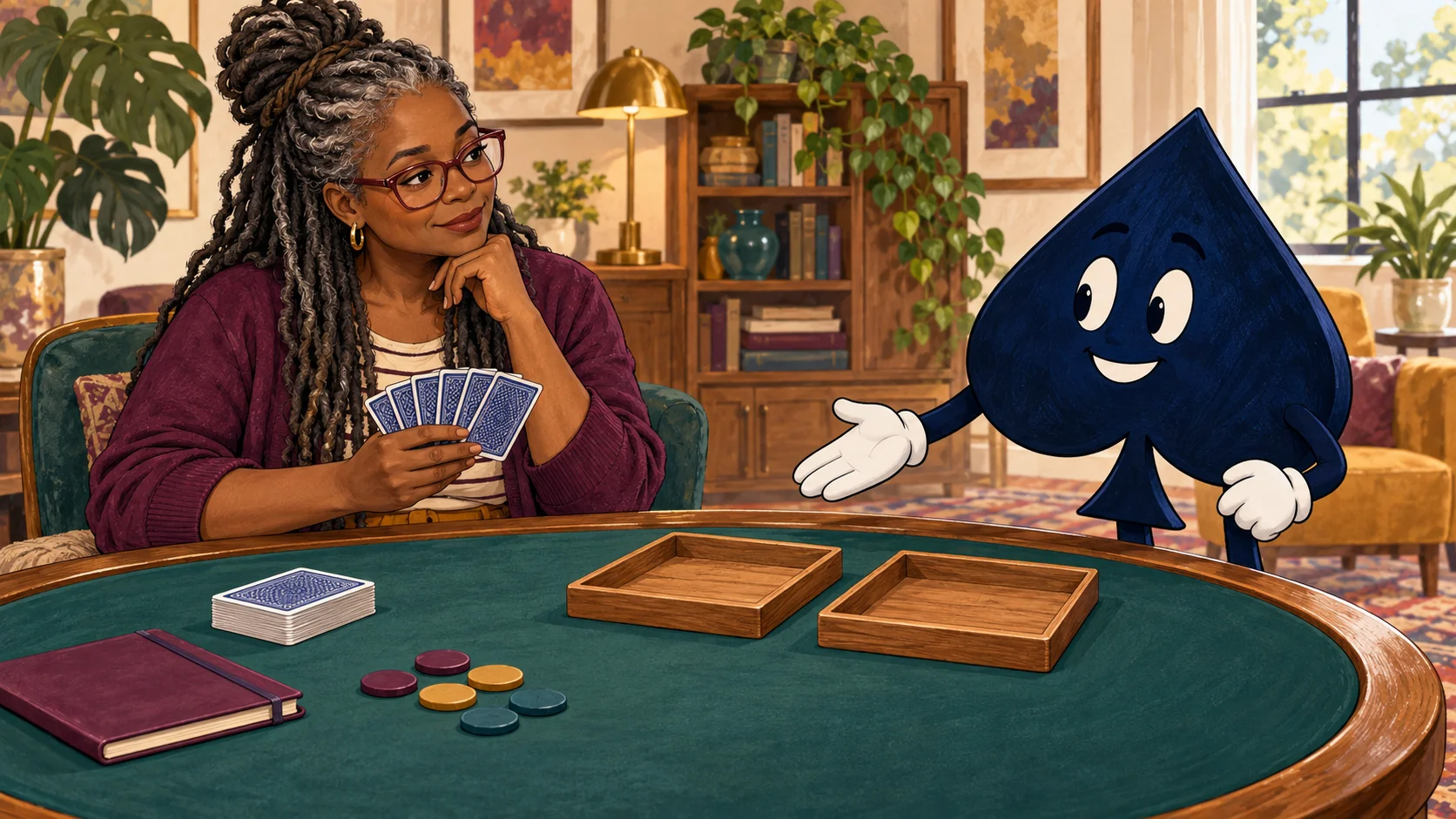
Amara and the HPD spade are working through a practice deal with two payout trays. Their task is to keep the hand selection separate from the accounting. The examples below use plain practice chips, exact cards and complete draw records. No money is needed to rehearse them.
Start with the part you need
If you already know A-5 Triple Draw, start with choosing the Badugi cards. If you know ordinary Badugi, read the five-card half first. Badacey gives you five cards to work with, rather than the four dealt in the standalone game.
For a full rehearsal, follow the betting schedule, then Amara’s hand. The six answer panels test selection, partial hands, changed winners and tied halves. They open independently, so you can leave the next answer hidden.
One holding, two separate results
Badacey, also written Badacy, is a split-pot draw game. This lesson uses a standard 52-card deck without a joker and a fixed-limit triple-draw format. At showdown, half the pot goes to the best five-card A-5 low. The other half goes to the best Badugi hand available within those same five cards. Aces are low for both evaluations.
| Half of the pot | Cards evaluated | Main comparison |
|---|---|---|
| Five-card A-5 low | All five final cards | Pairs matter; straights and flushes do not |
| Badugi | Best eligible selection of up to four cards | No repeated rank or suit; more eligible cards beats fewer |
You do not divide your holding into two separate piles that must share no cards. An ace used in the five-card low may also be part of the Badugi selection. Nor do you choose a four-card low for the first half: every final card counts there, including a paired or high fifth card.
Both awards are low-hand awards. There is no conventional high-poker half. There is also no eight-or-better qualifier here. A nine-low, or even a paired hand, can win the five-card half when the other surviving hands are worse. The Badugi half likewise remains available when nobody can use four eligible cards.
Read the A-5 low from the top down
For five different ranks, arrange them from highest to lowest with the ace below the deuce. Compare the highest rank first, then continue only while the ranks match. A 7-6-4-2-A beats 7-6-5-3-2: seven and six match, then four beats five. An ace at the bottom cannot repair a losing comparison higher up.
The best five-card pattern is 5-4-3-2-A, often called a wheel. All five cards may have the same suit without damaging that A-5 value. Consecutive ranks also carry no penalty. That freedom applies to the five-card half; it does not make repeated suits eligible in the Badugi selection.
Five different ranks beat any pair. Among paired hands, compare the pair rank before the remaining cards, with aces low. A pair of aces beats a pair of deuces. When the pair ranks match, compare the remaining ranks from highest downward. Beyond one pair, the category order continues with two pair, three of a kind, full house and four of a kind, from better to worse for low. The A-5 lesson gives the full within-category comparison table.
Choose the largest eligible Badugi selection first
A Badugi selection cannot repeat a rank or a suit. From five final cards, look for four that satisfy both conditions. Four suits alone are not enough if two selected cards share a rank. Four distinct ranks alone are not enough if two selected cards share a suit.
The number of eligible cards comes before their ranks. Any four-card Badugi beats every three-card hand. Any three-card hand beats every two-card hand, and two beats one. A high four-card Badugi therefore beats a very low three-card selection. You cannot volunteer to use fewer cards merely because they look prettier.
Among selections of the same size, compare their ranks from highest downward, with the ace low. A three-card 7-4-2 beats a three-card 7-5-A at the second comparison. If every selected rank matches, those Badugi hands tie. Suits do not break the tie, and an unselected fifth card is not a kicker.
The best possible four-card selection is 4-3-2-A with four different suits. If no four-card selection is legal, find the best three. If three is impossible, find the best two, then one. These partial hands still compete for the Badugi half; that half does not disappear or automatically transfer to the five-card winner.

A reliable paper method is to try every four-card selection before dropping to three. There are only five ways to omit one card from a five-card holding. Reject each selection with a repeated rank or suit, then compare the legal ones. If none works, examine the three-card selections. The second exercise shows why blindly keeping the lowest card of each suit can miss the best result.
Excluding a card from the Badugi evaluation is not another draw. It stays in the five-card hand and still affects the A-5 half. Write the selected Badugi cards underneath the full holding rather than crossing cards out of the hand record.
Award each half, then split any ties
- Find the winner or tied winners of the five-card A-5 half
- Find the winner or tied winners of the Badugi half independently
- Allocate half the pot to each result, then divide that half among its tied winners
- Add each player’s shares and check that the payouts total the original pot
Winning both halves outright is a scoop. Winning one half outright and tying the other with one opponent gives you three quarters of an evenly divisible pot. The opponent gets one quarter. If three players tie one half while only two tie the other, the two sets of winners need different divisors. Dividing the entire pot by the number of players will give the wrong answer.
The examples use pots that divide exactly into the stated shares. A real room has an odd-chip procedure, and all-in hands may create side pots that must be evaluated separately. Confirm those rules before play. Do not invent a suit tiebreaker or move a spare chip between halves to make a worksheet balance.
If everyone but one player folds, the remaining player wins without a two-hand showdown comparison. The split calculations here concern pots that reach showdown with more than one eligible player. A folded hand cannot receive either share.
Check the game name before using an ace
Badacey and Badeucey look similar across the table: five private cards, drawing opportunities and two low-hand awards. Their rankings differ. Badacey uses A-5 for the five-card half and an ace-low Badugi selection. The Badeucey profile compared here uses 2-7 for the five-card half and treats an ace as high in its Badugi half too.
| Rule | Badacey in this lesson | Badeucey comparison |
|---|---|---|
| Five-card low | A-5; ace low | 2-7; ace high |
| Five-card straight or flush | Ignored | Counts against the low |
| Ace in Badugi selection | Low | High |
| Best Badugi ranks | 4-3-2-A, four suits | 5-4-3-2, four suits |
The first exercise makes that reversal explicit. Do not carry ordinary ace-low Badugi evaluation into the Badeucey half by habit. For the five-card side of that comparison, the 2-7 Triple Draw guide explains why aces, straights and flushes are treated differently.
Three draws between four fixed-limit betting rounds
Use fixed-limit 6/12 for this lesson: the small bet is 6, the big bet is 12, and the blinds are 3 and 6. Those are practice-chip units, not a claim that every Badacey game uses these stakes. Badacey can also be offered with other betting structures; the amounts below apply to this fixed-limit rehearsal.
| Stage | Betting unit | What follows |
|---|---|---|
| Five private cards dealt; opening betting | 6 | Draw one |
| Betting after draw one | 6 | Draw two |
| Betting after draw two | 12 | Draw three |
| Betting after draw three | 12 | Showdown if still contested |
Before the first draw, action starts with the first active player clockwise from the big blind. The draws and later betting rounds begin with the first active player clockwise from the button. Folded players are skipped. Draw in turn, discard the chosen cards, and receive the same number of replacements. You may replace zero through five cards and finish each draw with five.
Taking zero cards is standing pat for that draw. You may draw on a later opportunity after standing pat earlier. Each draw has its own count. The counts tell you how many replacements were requested; they do not expose the ranks or prove that an opponent has a particular Badugi.
After draw two, an opening bet is 12 and a full raise makes the round total 24. A player who already contributed 12 adds only another 12 to call that raise. Previous betting rounds do not pay the new call. Raise caps, short all-ins and reshuffles follow the room’s rules; the worked hand needs no all-in ruling, no cap exception and no recycled discard.
Follow one deal all the way to a quartered pot
Clockwise around the table sit Amara on the button, Bram in the small blind, Kira in the big blind and Noor. Each starts with 240 chips. Bram posts 3 and Kira posts 6. Use the 6/12 schedule above, with no ante, fees or all-ins. The choices and replacements are prescribed for teaching, not recommended as optimal play.
Noor calls 6, Amara calls 6 and Bram adds 3 to complete the call. Kira checks the big-blind option. All four players have contributed 6, so the opening pot is 24.
| Player | Initial cards |
|---|---|
| Bram | A♠ 3♣ 6♥ J♠ Q♦ |
| Kira | A♥ 4♣ 7♦ 10♠ Q♣ |
| Noor | A♦ 2♣ 3♠ K♥ K♠ |
| Amara | A♣ 2♠ 3♥ 9♦ J♣ |
Draw one: the smaller bet stays in place
| Player | Discard | Receive | Hand after this draw |
|---|---|---|---|
| Bram | J♠ Q♦ | 2♥ 8♠ | 8♠ 6♥ 3♣ 2♥ A♠ |
| Kira | 10♠ Q♣ | 5♠ 9♣ | 9♣ 7♦ 5♠ 4♣ A♥ |
| Noor | K♥ K♠ | 4♥ Q♥ | Q♥ 4♥ 3♠ 2♣ A♦ |
| Amara | 9♦ J♣ | 4♦ 8♦ | 8♦ 4♦ 3♥ 2♠ A♣ |
Bram, Kira, Noor and Amara each draw two. Bram checks and Kira checks. Noor bets 6, then Amara, Bram and Kira each call 6. This round adds 24, taking the pot from 24 to 48.
Draw two: the bet becomes 12
| Player | Discard | Receive | Hand after this draw |
|---|---|---|---|
| Bram | 6♥ 8♠ | 5♥ 10♦ | 10♦ 5♥ 3♣ 2♥ A♠ |
| Kira | 7♦ 9♣ | 6♣ J♦ | J♦ 6♣ 5♠ 4♣ A♥ |
| Noor | Q♥ | 7♥ | 7♥ 4♥ 3♠ 2♣ A♦ |
| Amara | 8♦ | 6♦ | 6♦ 4♦ 3♥ 2♠ A♣ |
Bram and Kira draw two each; Noor and Amara draw one each. Bram checks and Kira checks. Noor bets 12 and Amara calls 12. Bram and Kira fold. Only 24 is added this round, so the pot is now 72. Bram and Kira made their second draws before folding; they will not receive a third draw.
Draw three: only two players remain
| Player | Discard | Receive | Hand after this draw |
|---|---|---|---|
| Noor | 7♥ | 8♥ | 8♥ 4♥ 3♠ 2♣ A♦ |
| Amara | 6♦ | 5♦ | 5♦ 4♦ 3♥ 2♠ A♣ |
Noor draws one, then Amara draws one. Noor bets 12, Amara raises to 24 and Noor adds another 12 to call. Each has contributed 24 during this round. The added 48 brings the final pot to 120.
Noor’s final replacement made the five-card low worse: the seven of hearts became the eight of hearts. The Badugi selection still uses the four of hearts, so its rank did not change. One draw can affect the two evaluations differently. That observation describes this deal; it does not establish which discard would have been best beforehand.
| Player | All five final cards | A-5 result | Best Badugi selection |
|---|---|---|---|
| Amara | 5♦ 4♦ 3♥ 2♠ A♣ | 5-4-3-2-A | 4♦ 3♥ 2♠ A♣ (4-3-2-A) |
| Noor | 8♥ 4♥ 3♠ 2♣ A♦ | 8-4-3-2-A | 4♥ 3♠ 2♣ A♦ (4-3-2-A) |
Amara wins the five-card half with a wheel, receiving 60. Both players have a four-suit 4-3-2-A for Badugi, so they divide the other 60 and receive 30 each. Amara receives 90 in total; Noor receives 30. Noor’s eight cannot break the Badugi tie because it is outside the selected four cards.
| Player | Before draws | After draw 1 | After draw 2 | After draw 3 | Total |
|---|---|---|---|---|---|
| Bram | 6 | 6 | 0 | 0 | 12 |
| Kira | 6 | 6 | 0 | 0 | 12 |
| Noor | 6 | 6 | 12 | 24 | 48 |
| Amara | 6 | 6 | 12 | 24 | 48 |
| Total | 24 | 24 | 24 | 48 | 120 |
| Player | Start | Contributed | Received | End |
|---|---|---|---|---|
| Bram | 240 | 12 | 0 | 228 |
| Kira | 240 | 12 | 0 | 228 |
| Noor | 240 | 48 | 30 | 222 |
| Amara | 240 | 48 | 90 | 282 |
| Total | 960 | 120 | 120 | 960 |
Amara finishes 42 ahead, not 90 ahead. Noor receives a quarter of the pot yet finishes 18 behind the starting stack. Bram and Kira each lose 12. The gains and losses balance, and all 960 starting chips are accounted for. A share of the pot is not a promise of a profitable hand.
The record contains 36 distinct physical cards across the initial deal and replacements. None of the discards reappears. You can trace every final card backward without pooling earlier holdings into the showdown. Real dealing procedures may require a reshuffle when the deck runs short; this particular example does not.
Six checks before you reveal the answers
Treat every numbered exercise as a new deal. A, K, Q, J and 10 mean ace, king, queen, jack and ten; ♠, ♥, ♦ and ♣ mean spades, hearts, diamonds and clubs. All listed players reach showdown, and the pot amounts are final, with no fees or side pots. Name both results before calculating the payout. Tab reaches each answer; Enter or Space opens and closes the panel.
1. A change of game changes both winners
This 80-chip pot is Badacey. Who wins each half? Then re-evaluate the same cards under the ace-high Badeucey profile described above.
| Player | Final five cards |
|---|---|
| A | A♠ 2♥ 3♦ 4♣ 5♣ |
| B | 2♣ 3♥ 4♠ 5♦ 7♣ |
Check exercise 1
A scoops all 80 in Badacey. Its five-card hand is a wheel, and its best Badugi selection is 4♣ 3♦ 2♥ A♠. B has a seven-low and a 5-4-3-2 Badugi, both worse under these ace-low rules.
In the stated Badeucey profile, B scoops instead. B has the clean 2-7 seven-low and a four-suit 5-4-3-2. A’s five-card hand is ace-high. A also needs the ace of spades to reach four different suits in the Badugi half, so its best four-card selection is ace-high there too. Neither half keeps its original winner.
2. The lowest card of a suit can block a selection
Choose the best Badugi selection from each holding, then award both halves of an 80-chip pot. Must A keep the ace of spades?
| Player | Final five cards |
|---|---|
| A | A♠ 2♠ A♥ 3♦ 4♣ |
| B | 5♠ 4♥ 3♣ 2♦ A♣ |
Check exercise 2
B wins the A-5 half with a wheel; A has a pair of aces. For Badugi, A uses A♥ 2♠ 3♦ 4♣ and leaves A♠ out of that evaluation. It is a perfect 4-3-2-A. Keeping A♠ and automatically rejecting 2♠ would block that four-card result because A♥ repeats the ace rank.
B’s best four-card selection is 5♠ 4♥ 2♦ A♣, a 5-4-2-A Badugi. A therefore wins the Badugi half. Each player receives 40. The ace of spades still belongs to A’s five-card holding; it was omitted only from the Badugi selection.
3. Nobody has a four-card Badugi
Find each player’s best eligible Badugi cards. Does a 96-chip pot still have two awards when neither player can use four cards?
| Player | Final five cards |
|---|---|
| A | A♠ 2♥ 3♣ 7♣ 9♥ |
| B | A♦ 2♣ 4♥ 6♥ 8♣ |
Check exercise 3
A uses A♠ 2♥ 3♣ for a three-card 3-2-A. B uses A♦ 2♣ 4♥ for a three-card 4-2-A. A wins the Badugi half at the first rank comparison, three against four. The unused cards do not become kickers.
B wins the five-card half because an eight-low beats a nine-low. The Badugi half remains awarded to A even though no full four-card Badugi exists. Each player receives 48.
4. A tied half is not a tied pot
Both players can show a four-suit 4-3-2-A. Divide the 120-chip pot. Does the fifth card change the Badugi tie?
| Player | Final five cards |
|---|---|
| A | A♠ 2♥ 3♦ 4♣ 5♣ |
| B | A♥ 2♦ 3♣ 4♠ 7♠ |
Check exercise 4
A wins the five-card half: its wheel beats B’s seven-low. Both best Badugi selections are four-suit 4-3-2-A, so the 60-chip Badugi half splits 30/30.
A receives 60 plus 30, totaling 90. B receives 30. The five and seven matter to the five-card result, but neither is a kicker for the tied Badugi selections.
5. Three winners on one side, two on the other
Divide a 180-chip pot between these three players. Check how many winners share each half before dividing anything.
| Player | Final five cards |
|---|---|
| A | A♠ 2♥ 3♦ 4♣ 5♣ |
| B | A♥ 2♦ 3♣ 4♠ 5♠ |
| C | A♣ 2♣ 3♠ 4♥ 5♥ |
Check exercise 5
All three five-card hands are wheels. They divide the 90-chip A-5 half three ways, receiving 30 each. A and B each have a four-suit 4-3-2-A. C has only clubs, spades and hearts, so its best Badugi selection has three cards: A♣ 3♠ 4♥.
A and B divide the 90-chip Badugi half, receiving another 45 each. Final payouts are A 75, B 75 and C 30. The total is 180. Dividing the whole pot equally would overlook the different winners of the second half.
6. Count eligible cards before reading their ranks
Which hand wins each half of this 64-chip pot? Also check the betting rule: after draw two in fixed-limit 6/12, can a player facing 12 make a full raise to 18? Assume enough chips and no all-in exception.
| Player | Final five cards |
|---|---|
| A | K♠ Q♥ J♦ 10♣ 10♥ |
| B | A♦ 2♥ 3♣ 4♣ 5♥ |
Check exercise 6
B wins the five-card half with a wheel; A has a pair of tens. A nevertheless has a legal four-card Badugi: K♠ Q♥ J♦ 10♣. B’s best selection is only A♦ 2♥ 3♣. Four eligible cards beat three before the high ranks are compared, so A wins the Badugi half. Each receives 32.
A full raise after draw two is to 24: match 12 and raise another 12. A raise to 18 adds only 6 and is not a full fixed-limit raise in this stated example. The larger unit already applies after the second draw.
Keep a two-result review record

The checklist below is a temporary aid for this visit, with no submission or saved progress. Tab moves between its labeled boxes; Space toggles the focused box. Keep any lasting practice record in your own notebook.
For another pass, cover the payout rows in the worked hand and rebuild the 90/30 result from the two final holdings. Then return to exercise 2 and explain why the ace of hearts belongs in A’s best Badugi selection while the ace of spades does not. Amara’s next challenge for the spade is to make those explanations without pointing at the answer panel.
Exact selection and careful accounting help you understand what happened. They do not tell you that a draw, call or raise was optimal, and the supplied replacement cards are not predictions. If you play for money, set an affordable loss limit and a stopping time beforehand. HPD’s limits and breaks guide covers that planning.
Return to the six exercises or use the arrow button to start the lesson again.