Responsible play limits and breaks
You can stop gambling now, without reaching a target, recovering a loss or completing this page. A break does not need to be earned by playing well. If gambling is affecting money needed for everyday life, sleep, relationships or your ability to choose when to stop, support is available and you do not need a diagnosis to ask for it.
This guide explains account controls and offers a short plan for stepping away. The planner asks for no balance, losses, income, health information or contact details.
Money controls Time and breaks Make a plan Find support
If you want to leave now, close the gambling activity and choose something else to do. You can ask someone you trust or a recognized support service for help with the next step.

Treat a limit as a boundary
A money limit should never become an amount you feel obliged to use. Having room below a limit does not establish that more gambling is affordable or a good choice. You can spend less, stop earlier or choose not to gamble at all.
Keep money for essentials, commitments and debt repayments out of gambling. Borrowing to continue or trying to win back money needed elsewhere can make the situation harder. A percentage of income cannot establish a safe amount to gamble.
A written plan does not activate a deposit limit in an account. To use an account control, follow the provider's official process and check when the setting takes effect.
Know what each financial control measures
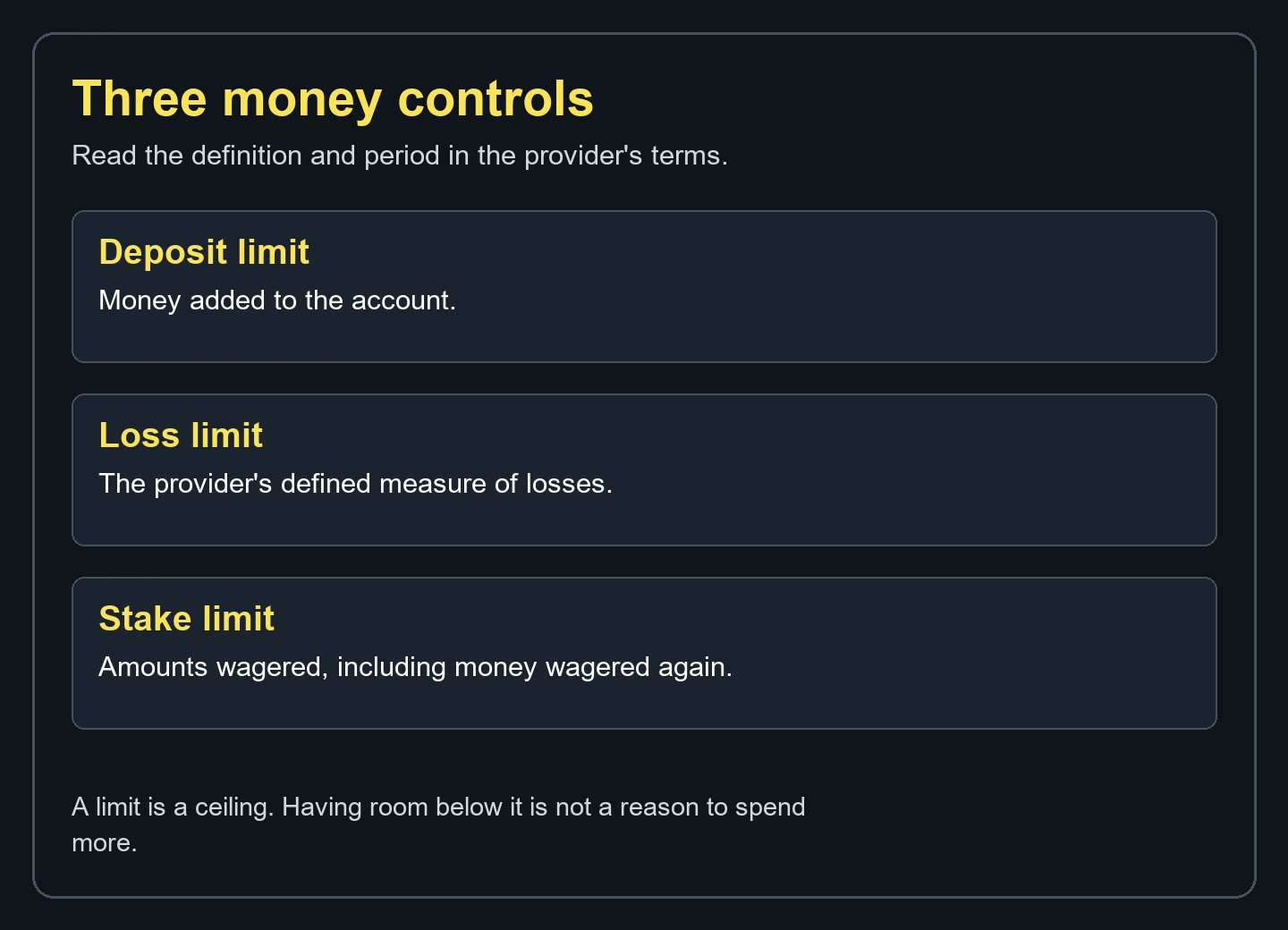
A deposit limit concerns money added to an account over a stated period. A loss limit concerns a defined measure of losses. A stake limit concerns amounts wagered. Those measures are not interchangeable, and an account balance can be affected by more than the amount most recently deposited.
For a fictional example, depositing twenty units and wagering those same units more than once can produce more than twenty units of total stakes. That is why a deposit cap and a stake cap measure different things. Twenty units is an illustration, not a suggested budget.
Check the provider's definitions, time period and scope. Does a control apply to one product, one account or several linked services? Does a period reset at a stated time or roll forward? What happens when you request a reduction or an increase? Do not assume a control covers places or payment methods that its terms never mention.
Time boundaries deserve their own plan
A money result does not tell you how much time a session has taken from the rest of your day. A session can interfere with sleep, work, meals or relationships even if the financial result looks acceptable. Time limits and stopping plans address a different part of the problem.
Name what you will do after you leave. Make food, move to another room, take a walk if that suits you, or contact someone you trust. Give the next few minutes something other than another game to revolve around.

A reminder is only a reminder unless the provider says it enforces a stop. A popup that can be dismissed is different from an account timeout. Read the tool's actual effect rather than assuming that setting a reminder has closed access.
Loss-chasing can change the stopping rule
Notice when the reason for continuing becomes "I need to get back to even" or "One more deposit will repair this." A previous loss does not create a requirement to keep gambling, and a future outcome is not obliged to repay it. A stopping rule tied to recovery can keep moving as the result changes.
You can pause without deciding today how every future day will look. Close the gambling activity, avoid adding more money and move to a nonplaying activity or a support conversation. If this is difficult to do, that is a reason to use more support rather than a reason to criticize yourself.
You can ask for help when a boundary feels difficult to keep or when gambling is making you uncomfortable. You do not need a particular loss amount or a diagnosis before that concern deserves attention.
A break, a timeout and self-exclusion do different jobs
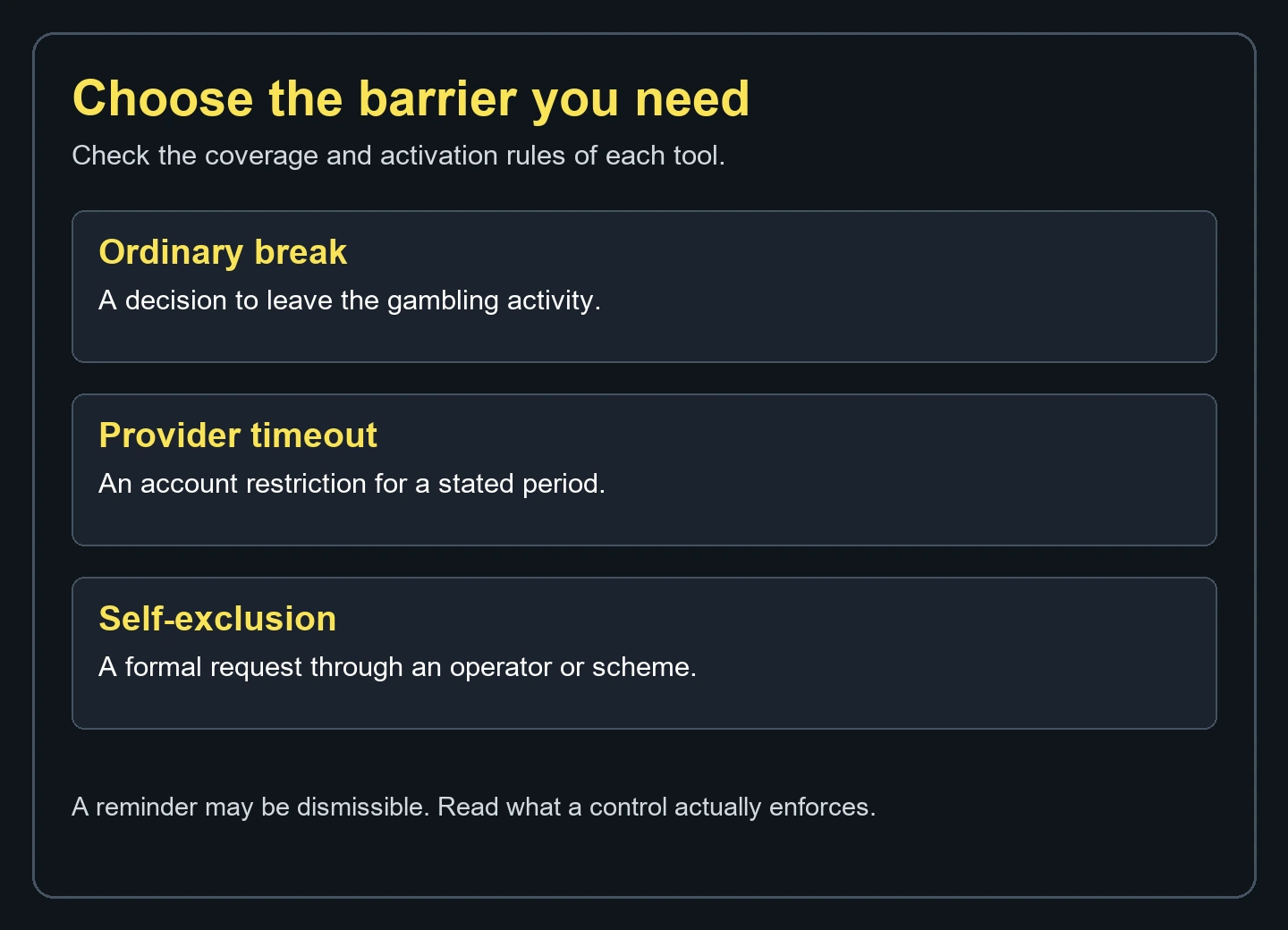
An ordinary break is a decision to stop participating for a while. A provider timeout can restrict access for a stated period, depending on its terms. Self-exclusion is a more formal request to prevent gambling through the covered operator or scheme. Availability, duration, coverage and reactivation rules differ.
If you are struggling to stay away, consider asking a specialist service about self-exclusion and other barriers. You do not have to work out every setting alone. Read the official scheme's coverage carefully, including which websites, apps or physical venues are included.
Keep a timeout, block or self-exclusion in place. If a barrier has not worked as expected, contact the provider or relevant scheme and ask for help strengthening the protection.
Add barriers where they are useful
Device blocking software, bank gambling-payment blocks and operator controls can address different routes to gambling. A combination may be more useful than relying on one reminder. None should be treated as proof that every possible route is covered.
Ask the bank or tool provider what its control blocks, how to activate it and what limitations apply. Use its official process and keep financial credentials private.
Review marketing preferences, app notifications and gambling-related content through their official settings. Removing a prompt can make it easier to spend your attention elsewhere.
Make a small nonplaying plan
Choose the obstacle you want help planning around: an urge to continue, easy access to gambling, or uncertainty about support. Then pick a next step with a trusted person, a specialist service, or on your own.
The worksheet suggests a nonplaying next step. It does not score you, start a countdown or tell you when to return to play.
The separate step-away button works without completing either choice. You can also use the written option below the form, or simply leave the page.
Changing a choice clears the old plan. Clear plan restores the starting options and removes the output. The module saves and sends nothing. To keep a reminder, write it somewhere you control.
Involving someone without giving away control
If there is a person you trust and feel safe approaching, a short request may be enough: "I'm taking a break from gambling and would appreciate some company while I do something else." You do not need to disclose every detail to ask for immediate support.
A trusted person can keep you company while you contact a service or review official blocking options. Keep passwords and banking codes private. Agree on the help you want.
If there is no suitable person to ask, a specialist gambling-support service can discuss practical steps and local help. It is enough to say you are unsure where to start.
Find support that covers your location
For UK support, the NHS lists gambling-support services, including GamCare, and explains routes to treatment in England. Gamstop Online provides self-exclusion for online gambling covered by its scheme. Check the official service's location, eligibility and coverage before relying on it.
Elsewhere, look for your local gambling regulator's player-support information, a recognized gambling-harm service or a healthcare professional who can direct you to appropriate help. Service coverage, languages and opening arrangements vary. This page does not assume that a British scheme applies worldwide.
If debt or unpaid essentials are involved, qualified debt advice can sit alongside gambling support. A poker result is not a debt-repayment plan. Keep the practical financial problem visible rather than setting a winnings target to make it disappear.
Read the NHS guide to help for problems with gambling for UK support routes and practical barriers. For online self-exclusion, read how Gamstop Online works and check which services it covers.
If a plan did not hold
A difficult day does not erase the value of asking for help. Look at what made access easy and what support was missing. You can strengthen a barrier, ask someone to stay with you while you contact a service, or choose a more complete break.
Keep the review practical. What would make the next nonplaying step easier to take? You do not have to recover a loss or prove anything before stopping.
If gambling is seriously affecting your mental health and you need urgent help, use your local urgent mental-health or emergency service. The NHS support page links to urgent help in the UK.
Check a control before relying on it
Open the official settings page and read the label beside the control. Write down the period it uses and the account or product it covers. If the wording is unclear, ask the provider to explain it before treating the setting as active. A confirmation screen or message can help you check that the request was received.
Pay attention to the difference between requesting a setting and the setting taking effect. A change may be immediate or may involve another step, depending on the tool. Read the current terms for reductions, increases, cancellation and reactivation. Avoid guessing a waiting period from what a different service does.
Check whether linked products share the same control. One account may have several products, while a scheme may cover only participating services in a particular place. If you use more than one service, a setting in one account should not be assumed to apply to the others. Ask the provider or scheme when the scope is uncertain.

Make the end of a session easier
Choose a stopping point before you open another table or register for an event. Think about the time needed for meals, sleep, travel and the people expecting you. If you cannot leave enough room for those commitments, skipping the session is an option. A planned end time does not create an obligation to play until then.
Tournament registration can commit more time than the entry process suggests. Before entering, consider what happens if the event runs into a commitment you need to keep. Check the format and schedule, and choose whether the event fits your day. The possibility of a long run should not become a reason to ignore sleep, work or family needs.
At the stopping point, use a concrete next action. Shut the client, put the device aside, and start the activity you chose earlier. An unfinished hand review or a wish to end on a winning session can wait. If you repeatedly move the stopping point, bring that difficulty to a support conversation and consider stronger access barriers.
Keep rewards and losses out of the decision to stop
A bonus target, loyalty tier or promotion deadline can add pressure to continue. Read its terms if you need to understand what will expire, then decide whether leaving is the right next step for you. Money or time already spent does not oblige you to spend more to finish a target. You can let a reward go.
The same applies after a loss. Reaching an even balance is an uncertain result, so it makes a poor condition for ending a session. If the reason for opening another table is to repair an earlier result, stop and use the nonplaying plan. A support service can help you talk through that pattern without asking you to win anything first.
A profitable session can also continue past a useful stopping point. Look at the time and the commitments you set aside, as well as the money result. Limits concern your ability to leave and protect the rest of your day. A positive balance does not settle whether continuing is a good choice.
Choose a support route you can use
If you are unsure what to say, start with the immediate difficulty: “I keep extending sessions”, “I am spending money needed elsewhere”, or “I want help staying away today.” You can ask what the service offers, which locations it covers, and how a first conversation works. Check its current privacy information if that affects your choice.
Support can also be useful for someone affected by another person’s gambling. The NHS page lists family and other support routes. A friend or family member does not need to manage a poker account to ask for help with the impact on their own life. Choose a recognized service that covers the person seeking support.
If the first route is unavailable, use another recognized local service or a healthcare professional who can direct you. For debt or unpaid bills, contact qualified debt advice as well. These conversations can address the practical problem while you keep a break in place. Keep any urgent safety concern separate from waiting for a routine appointment.
Sources and next steps
Official sources checked on 18 October 2026. Service coverage and provider settings can change. Follow the current instructions on the official support or account site.
The Info & tools hub has the rest of the site’s practical guides. You can return to it whenever you choose.