A-5 Triple Draw rules: keep the ace low and follow all three draws
Five cards in one suit can be a perfect low. In A-5 Triple Draw, 5-4-3-2-A wins even when every card is a spade. Straights and flushes are ignored, the ace sits below the deuce, and pairs still matter. Those rules deserve a fresh look if you learned another kind of lowball first.
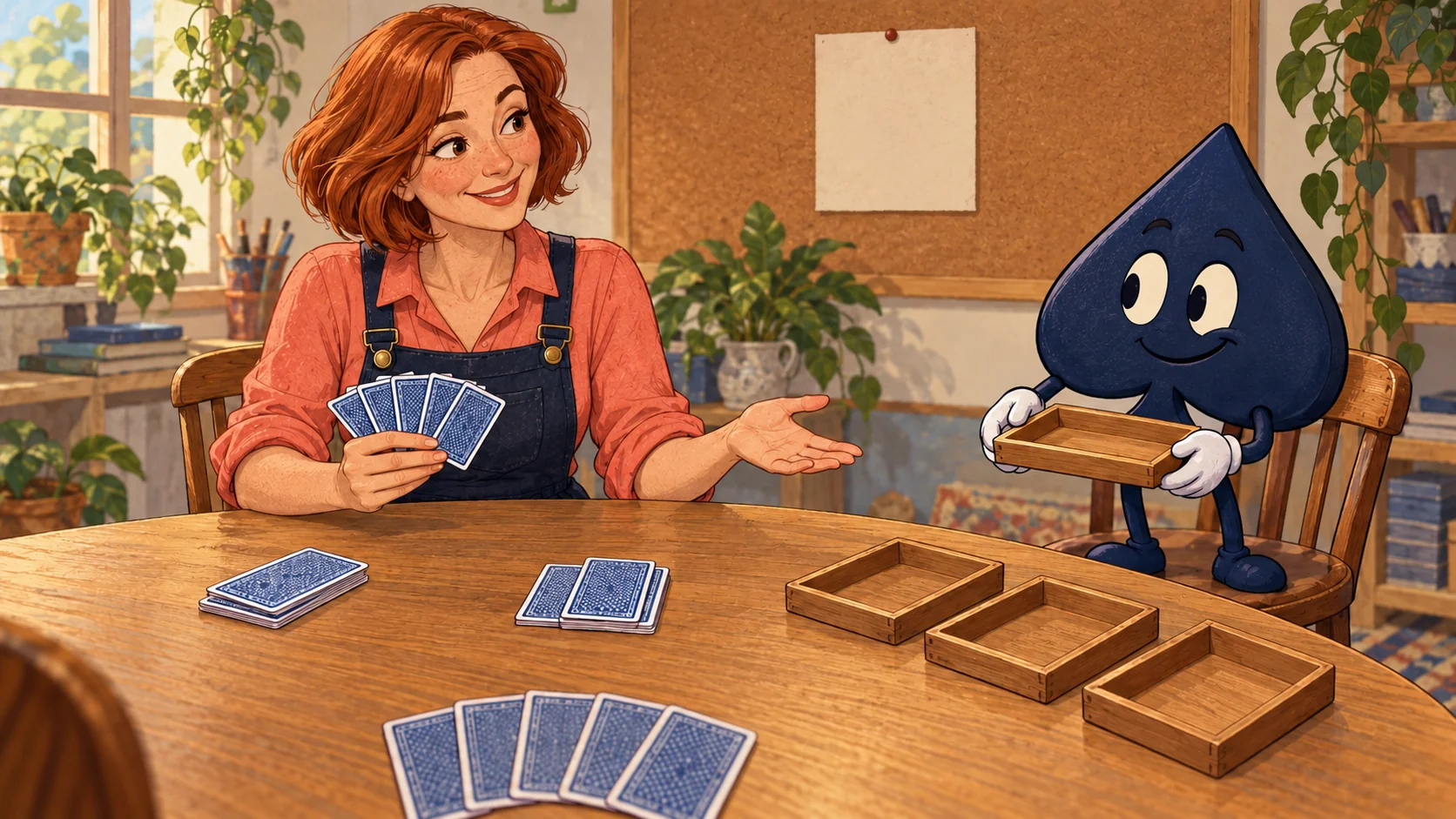
Petra has set out a deck, discard trays and a notebook for the HPD spade. Their practice hand runs through every draw and betting round, then finishes with two equal lows sharing a pot. Work through it with counters or paper. No money is needed to learn the sequence.
Choose a starting point
If you know 2-7 Single Draw, begin with the hands that change winners. The ace and suited-card rules are different here, as is the number of draw opportunities. If you know Razz, go to the draw procedure. The low-hand ranking will look familiar, but the deal and action order will not.
For a complete rehearsal, use the four-round schedule and Petra’s practice hand. The six exercises test ranking, draw history and the change in bet size. You can open their answers one at a time.
The same cards can produce a different winner
In ace-to-five lowball, the ace has the lowest rank. Five different ranks beat any paired hand. With no pair, compare the highest card first and continue downward only while the ranks match. Suits never improve or damage the low, and a consecutive run of ranks carries no straight penalty.
That makes 5-4-3-2-A the best rank pattern. A suited wheel and a mixed-suit wheel are equal. A six-low can also contain consecutive cards: 6-5-4-3-2 is a valid six-low here. You do not have to leave a gap in the ranks to avoid making a straight.
- In A-5, a suited 5-4-3-2-A beats a mixed-suit 7-5-4-3-2
- In 2-7, those hands reverse order: the ace-high flush loses to the clean seven-low
- In A-5, a mixed-suit 6-5-4-3-2 beats a seven-low; the straight pattern carries no penalty
The first two exercises give those comparisons exact suits. There is a useful lesson in the reversal: “lowball” on its own is not a complete set of hand rankings. Write A-5 at the top of a practice record before comparing anything.
There is no eight-or-better qualifier in the profile taught here. A nine-low is still a hand, and a pair can win if the other surviving hands are worse. This is low-only poker. A strong high hand does not claim a second half of the pot.
Read the complete low, not just the ace
Place the ranks in descending order with the ace at the bottom. For 7-6-4-2-A against 7-6-5-3-2, the seven and six match. Four then beats five, so the first hand wins. You do not need to compare the last two positions. An ace is useful, but it does not outrank an earlier difference in the wrong direction.
For example, 7-6-5-3-A loses to 7-5-4-3-2. The seven matches, then five beats six. Saying “I had an ace” leaves out the card that decided this comparison. Adding the ranks together is also unreliable. The winner comes from the first difference in order, not the smallest sum.
When people call a hand “six-four,” they mean its highest ranks begin six, four. Use the full five ranks whenever another hand has the same beginning. Equal rank patterns tie regardless of which suits appear, including when one hand happens to be all one suit.
| Best to worst category | What decides within that category |
|---|---|
| Five different ranks | Lower highest card, then lower next card, continuing until a difference |
| One pair | Lower pair, then lower remaining cards from highest downward |
| Two pair | Lower higher pair, then lower second pair, then lower kicker |
| Three of a kind | Lower trip rank, then lower remaining cards from highest downward |
| Full house | Lower trip rank, then lower pair |
| Four of a kind | Lower four-card rank, then lower kicker |
Aces stay low in paired hands too. A pair of aces beats a pair of deuces before the other three cards are compared. If the pair ranks match, compare the remaining cards from highest downward. Lower wins at the first difference. The words “ignore straights and flushes” do not mean you may ignore a pair.
For a paper check, imagine holding A-A-3-4-5. You have four distinct ranks and a pair of aces. You cannot discard one ace from the evaluation and call it a four-card wheel. A-5 Triple Draw uses the entire final five-card hand.
Five private cards, with three chances to replace them
This lesson uses a 52-card deck, no joker, a dealer button and small and big blinds. Every player receives five cards face down. After the opening betting round, surviving players may exchange zero through five cards on the first draw. The same opportunity comes again after the next betting round, and once more after the following one.
On each draw, the number of replacement cards equals the number discarded. Keeping two cards and replacing three still leaves a five-card hand. You never accumulate seven cards and choose the best five from them. Earlier discards are not extra cards available for a later showdown.
Before the first draw, betting begins with the first active player left of the big blind. Each draw begins with the first active player left of the button, as does each later betting round. Action proceeds clockwise. A folded player is skipped. These positions, rather than anybody’s visible card ranks, determine who starts.
That is the procedural difference from Razz. Razz develops a seven-card stud hand, uses exposed cards and has a bring-in. Here the players exchange private cards while the button and blinds organize the action. Knowing the common A-5 ranking does not make the dealing procedures interchangeable.
Standing pat means taking zero cards on that particular draw. You may stand pat on the first draw and exchange a card on the second. You may also draw once and stand pat on the two remaining opportunities. Record all three counts separately, such as 0 / 1 / 1 or 2 / 1 / 0. They describe a sequence, not a promise to keep the same hand forever.

Do not treat a draw count as an exposed hand. A player who takes one card has shown you how many replacements they requested, not which ranks they kept. If the hand record does not reveal the private cards, leave those details unknown.
A real game can exhaust the undealt cards, particularly when several players draw repeatedly. The room’s dealing and reshuffle rules control what happens next. Our examples need no reshuffle and never recycle a discarded card. That makes their card histories easy to audit; it is not a universal claim that a card discarded early in any triple-draw game can never reappear.
The bet doubles after the second draw
Use fixed-limit 4/8 for this rehearsal. The small bet is 4 and the big bet is 8. Blinds are 2 and 4. The label 4/8 names the betting units in this example, not a small blind of 4 and a big blind of 8.
| When the betting occurs | Round | Full bet or raise increment |
|---|---|---|
| After the initial deal, before draw one | 1 | 4 |
| After draw one | 2 | 4 |
| After draw two | 3 | 8 |
| After draw three | 4 | 8 |
The first exchange does not trigger the larger bet. After draw one, an opening bet is still 4. After draw two, it is 8. If a player bets 8 in that third betting round, a full raise makes the total 16 for the round. The raiser is matching 8 and adding an 8-chip raise.
A call adds only what the player still owes. If you have already put 8 into that round and the total becomes 16, you add another 8. Do not count the full 16 again. Start a new round column when the next betting round begins; a contribution from an earlier round does not pay the new call.
Fixed-limit controls the sizes of full bets and raises. It does not promise that a hand will cost only one bet, or that a whole session has a fixed loss. Raise caps, short all-ins, reopening rules and heads-up exceptions depend on the room and format. The practice hand below uses one raise at most in a round and has no all-ins, so none of those edge cases is needed.
Before playing elsewhere, confirm the exact game and structure. California single-draw rules may mention a joker, a rule about betting a seven, or restrictions on check-raising. Those are not additions to the no-joker triple-draw profile used in this lesson. A familiar low-hand name is not permission to mix different house rules together.
A full hand with three draw records and one shared pot
Clockwise around the table sit Petra on the button, Dax in the small blind, Emi in the big blind and Faye. Each starts with 200 practice chips. Use the 4/8 fixed-limit schedule above, blinds of 2/4, no ante and no fees. All replacements and betting actions are prescribed teaching examples, with no claim that these choices are optimal.
Dax posts 2 and Emi posts 4. Faye raises to 8, Petra calls 8 and Dax folds. Emi adds 4 to call. The live players have each contributed 8, plus Dax’s 2, so the opening pot is 26.
| Player | Initial five cards |
|---|---|
| Emi | A♠ 2♦ 6♣ J♥ Q♠ |
| Faye | A♥ 3♣ 5♦ 7♠ K♦ |
| Petra | A♣ 2♥ 4♠ 5♣ Q♦ |
Draw one, then another small-bet round
| Player | Discard | Receive | Hand after draw one |
|---|---|---|---|
| Emi | J♥ Q♠ | 4♥ 8♦ | 8♦ 6♣ 4♥ 2♦ A♠ |
| Faye | K♦ | 2♣ | 7♠ 5♦ 3♣ 2♣ A♥ |
| Petra | Q♦ | 9♦ | 9♦ 5♣ 4♠ 2♥ A♣ |
Emi draws two; Faye and Petra draw one each. Emi checks, Faye bets 4, Petra calls 4 and Emi calls 4. That adds 12 to the pot. It now contains 38. The bet stayed at 4 because only the first draw has been completed.
Draw two, then the big-bet round
| Player | Discard | Receive | Hand after draw two |
|---|---|---|---|
| Emi | 8♦ | 3♠ | 6♣ 4♥ 3♠ 2♦ A♠ |
| Faye | 7♠ | 6♥ | 6♥ 5♦ 3♣ 2♣ A♥ |
| Petra | 9♦ | 7♥ | 7♥ 5♣ 4♠ 2♥ A♣ |
Emi bets 8, Faye calls 8 and Petra raises to 16. Emi adds 8 and Faye adds 8, so each live player contributes 16 during this round. The round adds 48 to the previous 38, giving a pot of 86. A raise to 16 is a total of 16, not another 16 added on top of a call.
Draw three, then the last betting round
| Player | Discard | Receive | Final five cards |
|---|---|---|---|
| Emi | None | None | 6♣ 4♥ 3♠ 2♦ A♠ |
| Faye | 6♥ | 4♦ | 5♦ 4♦ 3♣ 2♣ A♥ |
| Petra | 7♥ | 3♦ | 5♣ 4♠ 3♦ 2♥ A♣ |
Emi checks, Faye bets 8 and Petra raises to 16. Emi folds. Faye adds 8 to call, reaching a total of 16 for this round. Faye and Petra have added 32 between them, so the final pot is 118.
Faye and Petra both show 5-4-3-2-A. Their suits differ, but each has the same wheel. They split the whole 118-chip pot, receiving 59 each. There is no high half to award. Emi’s six-low would lose to either wheel, and the fold has already removed Emi from the showdown.
| Player | Before draws | After draw 1 | After draw 2 | After draw 3 | Total |
|---|---|---|---|---|---|
| Dax | 2 | 0 | 0 | 0 | 2 |
| Emi | 8 | 4 | 16 | 0 | 28 |
| Faye | 8 | 4 | 16 | 16 | 44 |
| Petra | 8 | 4 | 16 | 16 | 44 |
| Total | 26 | 12 | 48 | 32 | 118 |
| Player | Start | Contributed | Pot received | End |
|---|---|---|---|---|
| Dax | 200 | 2 | 0 | 198 |
| Emi | 200 | 28 | 0 | 172 |
| Faye | 200 | 44 | 59 | 215 |
| Petra | 200 | 44 | 59 | 215 |
| Total | 800 | 118 | 118 | 800 |
Receiving 59 is not the same as gaining 59. Faye and Petra each contributed 44, so each finishes 15 chips ahead of the starting stack. Dax and Emi lost 2 and 28 respectively. Their combined 30-chip loss matches the winners’ combined 30-chip gain.
Trace one card before you move on. Petra received the nine of diamonds on draw one, discarded it on draw two, then discarded the seven of hearts on draw three. Neither earlier replacement belongs to Petra’s final wheel. A record that pools every card received during the hand would be describing an impossible showdown hand.
Six exercises with separate answer panels
Treat each numbered exercise as a new deal. A, K, Q, J and 10 mean ace, king, queen, jack and ten. The suits ♠, ♥, ♦ and ♣ mean spades, hearts, diamonds and clubs. Say the winner and the decisive comparison before opening an answer. Tab reaches each panel; Enter or Space opens and closes it without JavaScript.
1. A wheel in one suit
Who wins in A-5? Then ask what would happen to the same cards in 2-7.
| Player | Final cards |
|---|---|
| A | 5♠ 4♠ 3♠ 2♠ A♠ |
| B | 7♦ 5♥ 4♣ 3♥ 2♦ |
Check exercise 1: the suited wheel
A wins in A-5 with 5-4-3-2-A. The matching suits do not change its value. B has a seven-low, which loses to the wheel.
In 2-7, B wins. A’s ace is high and the five spades make a flush, while B has the best clean 2-7 rank pattern. Changing the game name changes the winner even though no physical card moved.
2. A run of consecutive ranks
The first hand looks like a straight. Is that a problem in A-5, and does the result change in 2-7?
| Player | Final cards |
|---|---|
| A | 6♠ 5♦ 4♥ 3♣ 2♠ |
| B | 7♥ 5♣ 4♦ 3♠ A♦ |
Check exercise 2: ignore the straight pattern
A wins in A-5. Its six is lower than B’s seven, and the consecutive ranks do not count against it. The missing ace does not prevent A from making a better low here.
Under 2-7 rules, A has a six-high straight and B has an unpaired ace-high hand. B wins in that system because the unpaired category beats a straight. This is a second reversal, with a different reason from the suited-wheel example.
3. Two seven-sixes need another comparison
Both highest cards match, then both second-highest cards match. Where does this hand end?
| Player | Final cards |
|---|---|
| A | 7♠ 6♦ 4♣ 2♥ A♠ |
| B | 7♥ 6♣ 5♦ 3♠ 2♣ |
Check exercise 3: four beats five
A wins with 7-6-4-2-A against 7-6-5-3-2. The third comparison, four against five, settles it. There is no need to use the ace as a separate tie-break.
Calling both hands “seven-six” is accurate but incomplete. A full hand record needs enough ranks to show why one seven-six beat the other.
4. Two paired hands meet an unpaired king
A and B each hold one pair. C has five different ranks. Put all three hands in A-5 order, best first.
| Player | Final cards |
|---|---|
| A | A♠ A♥ K♦ Q♣ 9♠ |
| B | 2♠ 2♦ 5♣ 4♥ 3♦ |
| C | K♠ Q♥ J♦ 10♣ 9♣ |
Check exercise 4: C, then A, then B
C wins. Its five different ranks beat either paired hand, and its consecutive ranks carry no straight penalty in A-5. Among the paired hands, A’s pair of aces is lower than B’s pair of deuces, so A finishes ahead of B.
A’s king and queen would matter if the pair ranks tied. They do not overturn the lower pair here. Ignoring straights and flushes does not remove the distinction between a pair and five different ranks.
5. Pat first, then two changes
A stands pat on draw one, then changes a card on each remaining draw. Are those later exchanges permitted, and what is the final result against B?
| Record | Cards |
|---|---|
| A initial hand | 8♠ 5♦ 4♣ 2♥ A♠ |
| Draw 1 | Stand pat; no cards leave or arrive |
| Draw 2 | Discard 8♠; receive 7♣ |
| Draw 3 | Discard 7♣; receive 3♦ |
| A final hand | 5♦ 4♣ 3♦ 2♥ A♠ |
| B final hand | 6♥ 5♣ 4♦ 2♠ A♣ |
Check exercise 5: standing pat was not permanent
The exchanges are permitted. Standing pat on the first draw did not lock A’s hand for the rest of the deal. After the stated replacements, A has a wheel and beats B’s six-low.
A received two replacement cards across three opportunities. The seven of clubs was one of them, but it was later discarded. The final hand contains the three of diamonds instead. There is no fourth draw after this point.
6. The big bet and an equal low
In the 4/8 practice profile, you have just finished the second draw and face a full bet of 8. With no all-in exception, is a full raise to 12 or to 16? Later, the following two hands reach showdown for a final 60-chip pot. Work out their shares.
| Player | Final cards |
|---|---|
| A | 6♠ 4♠ 3♠ 2♠ A♠ |
| B | 6♦ 4♥ 3♣ 2♦ A♥ |
Check exercise 6: raise to 16, then split 30 each
A full raise is to 16. After draw two, the full raise increment is 8: match the 8 and add another 8. A raise to 12 would add only 4 and does not fit this full-bet example.
At showdown the hands are equal 6-4-3-2-A lows. The flush pattern in A’s cards is ignored, so each receives 30 of the 60 chips. Starting stacks and earlier contributions are not given for this exercise; the 30-chip share alone does not establish a net gain.
Make the next review easy to check

Use the boxes below after a practice deal. Each has a visible label; Tab moves between them and Space toggles the focused box. They are temporary controls on this page, with no submission or saved progress. Keep any lasting hand notes in your own notebook.
A short practice note can be enough if it contains the right facts. Write the button and blinds, the four round totals, the three draw counts, and the final shown cards. Mark unseen cards as unknown. Do not fill an opponent’s hand in from a draw count just because the story sounds plausible.
For a second pass, return to exercises 1 and 2 and explain both ranking systems without looking at the answers. Then close the panels and reconstruct Petra’s three exchanges. These checks test whether you understand what changed, rather than whether you recognize a winning hand from memory.
Accurate rankings and chip records are the beginning of a decision review. They do not prove that a discard or raise was the best choice, and the supplied replacements are not predictions. Poker involves risk; if you play for money, decide what you can afford to lose and when you will stop beforehand. HPD’s limits and breaks guide covers that planning.
Try the six exercises again or use the button to return to the lesson’s beginning.