Badeucey rules: score both halves before splitting the pot
Badeucey gives you five cards and two different jobs at showdown. All five make your deuce-to-seven low hand. A selection of up to four makes your ace-high Badugi hand. Each result is worth half the pot, so a player can win one half, share one half or collect both.
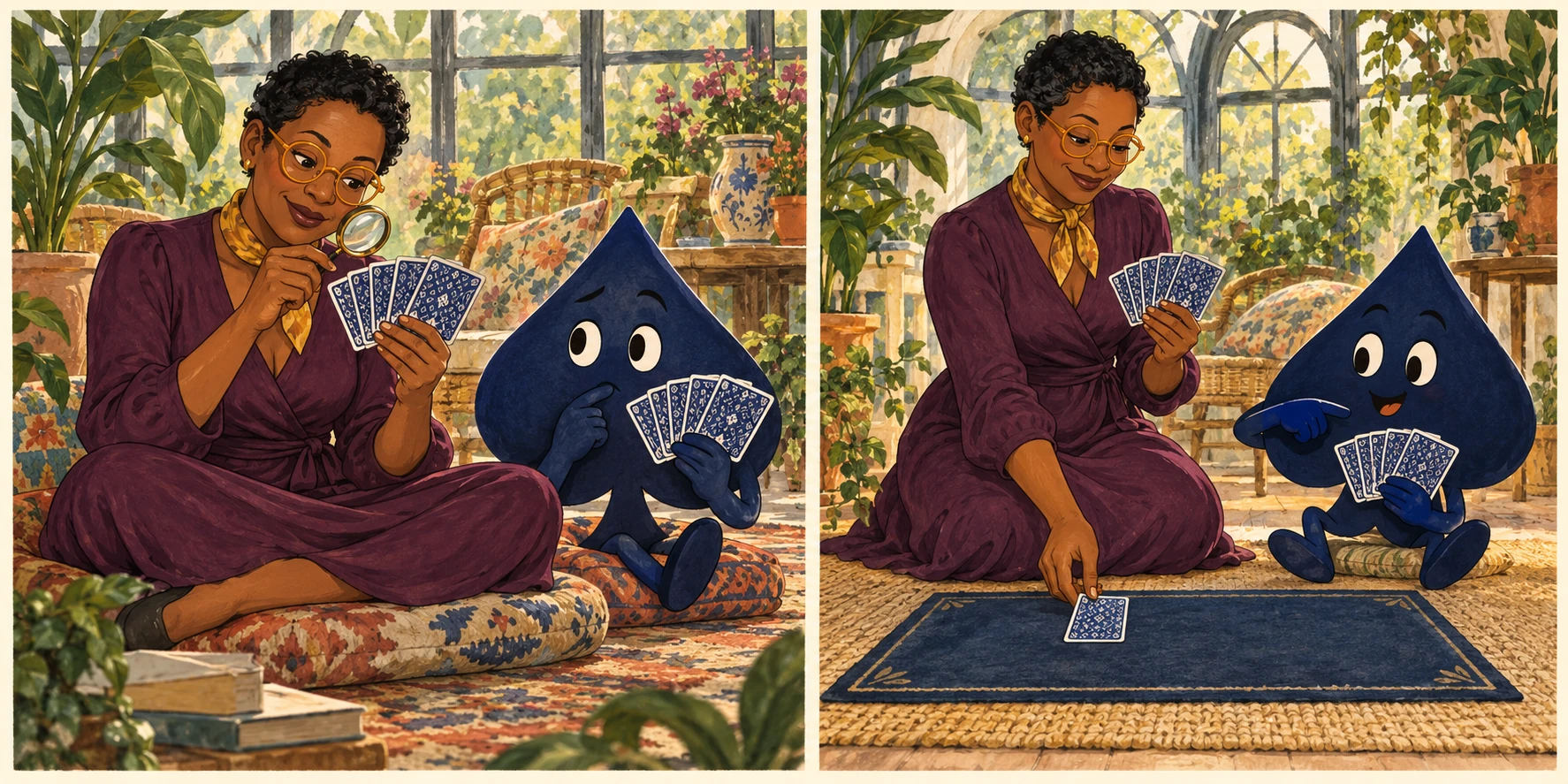
Imani has put two bowls on the study table. The HPD spade wants to push everything into the bowl beside its best-looking cards. She asks it to wait. First write down the five-card result. Then find the best Badugi selection. The chips move only after both comparisons are finished.
This lesson uses the ace-high Badeucey profile and imaginary chips. You may also see the name written Badeucy or Baduci. The spelling does not give you another set of cards or a different pot to win.

Choose the part you want to practice
Start with the two-score method if the name is new. Go to selecting the Badugi hand if repeated ranks or suits trip you up. The manual checklist and six exact-card exercises work together. Try each case on paper before opening its answer.
The table profile used here
We use a standard 52-card deck without jokers, five private cards per player, three draws and four betting rounds. Our practice betting structure is fixed-limit 4/8, with blinds of 2 and 4. The 4/8 label describes the two betting units. It does not describe the blinds.
Aces are high on both halves in this profile. The Badugi half therefore has a different best hand from ordinary ace-low Badugi. Keep that change in view even if you already know how to remove duplicate ranks and suits.
Badeucey can also be offered with other betting structures. Confirm the room’s game description, stakes, raise cap, all-in procedure and odd-chip rule. The fixed-limit amounts below belong to this practice table; the game name alone does not establish them.
Our showdown examples have one pot, no rake, no side pots and no uncalled excess to return. Cases 1 through 5 begin with completed hands, rather than reconstructing their earlier bets. Case 6 includes the last draw and last betting round. The numbered cases are independent deals, so cards may reappear in a different case.
Give every holding two scores
| Question | Five-card 2-7 half | Ace-high Badugi half |
|---|---|---|
| Which cards count? | All five cards in the final holding | The best eligible selection of up to four |
| What makes a selection eligible? | The full five-card hand is ranked, even if paired | No repeated rank and no repeated suit within the selection |
| What does an ace mean? | High | High |
| How do straights matter? | A five-card straight counts against the low | Consecutive ranks do not create a straight penalty |
| How do suits matter? | Five cards of one suit make a flush | Repeated suits prevent those cards being used together |
| What wins first? | The better 2-7 category, then the lower rank comparison | More eligible cards, then the lower rank comparison |
The two scores use the same final holding. Cards are not consumed by one half. A card used in the Badugi selection still belongs to the five-card hand. You do not divide your holding into a five-card pile and a separate four-card pile; that would require nine cards.
Likewise, setting a card aside while checking a Badugi subset is only a scoring aid. It is not a draw or a discard. Put all five back together before reading the 2-7 result. That distinction matters most when the ignored Badugi card is the one that creates a pair or a straight in the full holding.
Read the five-card half without improving it on paper
The strongest 2-7 hand is 7-5-4-3-2 with at least two suits. For ordinary unpaired hands that are neither straights nor flushes, compare from the highest rank downward. An eight-low beats a nine-low. If both start with an eight, compare the next rank, then continue until they differ.
Do not add the ranks together. A low hand is an ordered comparison. For example, 8-6-4-3-2 beats 8-7-4-3-2 at the second card. The matching low cards at the bottom cannot repair the losing seven.
Pairs, straights and flushes remain live hands. They are simply weaker lowball categories. An unpaired non-straight, non-flush hand beats a pair; a pair beats two pair, which beats three of a kind, then a straight, then a flush. Full houses, four of a kind and straight flushes are weaker still. Within a category, the lower relevant ranks win.
There is no eight-or-better qualifier here. A player does not lose eligibility for the 2-7 half merely by having a nine, king, ace or pair. Compare what the players actually hold. Compare pair ranks first. If those tie, compare the remaining cards from highest downward.
An ace never becomes a one. A mixed-suit A-5-4-3-2 is ace-high, not a five-high straight. A mixed-suit 6-5-4-3-2 really is a straight. The 2-7 Triple Draw lesson gives the five-card ranking and draw procedure more room; Badeucey adds a second result to that same five-card evaluation.
Find the largest legal Badugi selection first
For the Badugi half, look for four cards with four different ranks and four different suits. If you cannot make four, look for three, then two, then one. A four-card hand beats every three-card hand, however high its ranks are. Once the card counts match, compare ranks from highest to lowest, with the lower first difference winning.
The best possible Badeucey Badugi is 5-4-3-2 in four suits. A 5-4-3-2 selection is allowed even though its ranks run consecutively. Badugi has no straight category. Suit uniqueness is already part of eligibility, so a four-card flush is not a competing Badugi category either.
An ace can be used. It is high, so an ace-high four-card selection loses to any four-card selection without an ace, but still beats every three-card selection. Calling an ace “bad” is too vague to settle a hand. Count the eligible cards first, then compare their ranks.
Avoid choosing cards one at a time and refusing to reconsider the first choice. Two cards of the same rank may connect to different suits. Keeping one can block a useful third card, while keeping the other permits four cards. Case 1 makes that conflict visible.
With five cards, there are only five possible four-card subsets: omit each card once. Check each subset for repeated ranks or suits. If none works, there are ten three-card subsets to inspect. You can do this slowly with a paper deck. Speed comes after you stop overlooking the best selection.
Once two Badugi selections have the same card count and ranks, they tie. Suits establish whether the selection is legal; they do not break the tie. A fifth unused card is not a Badugi kicker. It can change the 2-7 half while leaving the Badugi half tied, which is exactly what happens in Case 4.
Three draws, with a bet after the last one
| Stage | What you do | Fixed-limit unit |
|---|---|---|
| Before draw 1 | Bet after the initial five-card deal | 4 |
| Draw 1, then betting round 2 | Exchange zero to five cards, then bet | 4 |
| Draw 2, then betting round 3 | Make a new exchange decision, then bet | 8 |
| Draw 3, then betting round 4 | Complete the final exchange, then bet | 8 |
| Showdown if needed | Score both halves and settle the pot | No further draw |
Each draw replaces the number of cards you discard. Standing pat means replacing zero on that draw; it does not commit you to stand pat later. You still have only five cards after each exchange. There is no separate draw for each half.
At a table with three or more players, the opening betting round starts after the big blind. Draws and later betting begin with the first active player clockwise from the button. Follow the dealer’s procedure for announcing and replacing cards. A room’s reshuffle rules matter when the deck runs short; none of our card histories requires a reshuffle.
The larger unit begins after the second draw. In an 8-chip round, a bet is 8 and a full raise adds 8 to the amount being faced. A raise to 16 is a total of 16 for that round, not 16 on top of an 8-chip call. We do not use short all-ins or cap-reaching raises in these examples.
A replacement can help one half and hurt the other. Keep two before-and-after descriptions when reviewing a draw: the full five-card category and the best Badugi selection. A result that improves only one line is still a real change. Whether the draw was a good decision also depends on information the finished cards alone cannot provide.
Split the pot before splitting a tie
At showdown, separate the pot into equal 2-7 and Badugi halves. Find the winner or tied winners of each half independently. Divide only the tied half among its winners, then add each player’s receipts from the two halves.
Winning one half outright and tying the other with one opponent earns three quarters of the whole pot. Losing one half and sharing the other with one opponent earns one quarter. Neither fraction tells you the net profit until you subtract that player’s contribution.
If three players tie one half, each receives one sixth of the total pot from that half. The other half still follows its own result. Do not divide the entire pot by the number of names written anywhere on the winner sheet.
A player who wins both halves scoops. A player who wins the 2-7 half does not automatically scoop when nobody makes a four-card Badugi. The best partial Badugi still wins its half. Case 6 shows a scoop that has to be earned by both comparisons, even though both players have only three-card Badugi hands.
All amounts here divide evenly into whole chips. For a real pot with an odd chip, apply the room’s rule rather than silently rounding both halves down. If there are all-ins or unequal matched contributions, establish pot eligibility and uncalled returns first. Then evaluate each eligible pot separately.
A manual showdown checklist
Use these boxes while checking one case. They are manual controls, not an automatic evaluator or a saved score. Clear them before the next case. On a keyboard, move to a box with Tab and toggle it with Space.
Six exact-card exercises
The suit symbols are clubs ♣, diamonds ♦, hearts ♥ and spades ♠. A means ace and K means king. Read every suit, even when you already know which five-card low is better. Write the Badugi cards themselves, not just a label such as “seven-low”.
1. Which deuce lets you use four cards?
You hold 2♣ 2♦ 3♣ 4♥ 7♠. Name the five-card 2-7 category and the best Badugi selection. A tempting first move is to keep the 2♣ and ignore the other deuce. Does that choice leave room for four legal cards?
Reveal the best selection and the rejected alternatives
The full five-card hand has a pair of deuces, with 7, 4 and 3 as its other ranks. You cannot remove a deuce from that five-card evaluation.
The best Badugi selection is 7♠ 4♥ 3♣ 2♦, a four-card 7-4-3-2. It has one spade, one heart, one club and one diamond, with no repeated rank. Leave out the 2♣ for this half only.
There are five ways to leave out one card. Omitting 2♣ produces the valid four-card selection. Omitting 2♦ leaves both 2♣ and 3♣, so a suit repeats. Omitting 3♣, 4♥ or 7♠ leaves both deuces, so a rank repeats. That checks every four-card candidate.
Keeping 2♣ at all costs limits you to three eligible cards. Replacing that choice with 2♦ allows the 3♣ to stay. The lowest rank alone was not enough information; its suit changed what could fit beside it.
2. A straight on one half, the best hand on the other
| Player | Final five cards |
|---|---|
| A | 2♣ 3♦ 4♥ 5♠ 6♣ |
| B | 2♦ 3♥ 4♠ 6♦ 8♣ |
The pot is 80 chips. Award each half. Does A’s run of low ranks win the five-card comparison? Does that same run prevent a legal Badugi?
Reveal the two winners and the 80-chip split
A has a six-high straight, 6-5-4-3-2. B has an unpaired 8-6-4-3-2 that is neither a straight nor a flush, so B wins the 2-7 half.
A selects 5♠ 4♥ 3♦ 2♣ for a 5-4-3-2 Badugi, the best possible Badeucey Badugi. B selects 8♣ 4♠ 3♥ 2♦ for 8-4-3-2. B cannot replace the 8♣ with 6♦ while retaining 2♦, because that would repeat diamonds.
A wins the Badugi half. Each half is 40, so A receives 40 and B receives 40. A’s straight remains a straight for the five-card half, while its legal four-card subset has no straight penalty. Both descriptions are true at once.
3. Can an ace-high Badugi beat three tiny cards?
| Player | Final five cards |
|---|---|
| A | A♠ 2♣ 3♦ 4♥ 7♣ |
| B | 2♥ 3♠ 4♦ 5♥ 7♠ |
The pot is 100. A can make four eligible cards only by keeping the ace. B has the best possible five-card 2-7 ranks. Decide whether either player scoops.
Reveal why card count comes before ace height
B wins the 2-7 half with 7-5-4-3-2. A’s full holding is ace-high, A-7-4-3-2.
A’s best Badugi is A♠ 4♥ 3♦ 2♣, an ace-high four-card hand. The 7♣ is left out. B has only hearts, spades and diamonds, so cannot make four suits. B’s best selection is 4♦ 3♠ 2♥, a three-card 4-3-2.
A wins the Badugi half because four cards beat three. The ace is high and eligible in this profile. It does not turn into a one, and it does not make A’s four-card hand disappear. A receives 50 and B receives 50.
4. Same Badugi, different fifth card
| Player | Final five cards |
|---|---|
| A | 2♣ 3♦ 4♥ 5♠ 8♣ |
| B | 2♦ 3♥ 4♠ 5♣ 9♦ |
The pot is 120. A and B each contributed 48; a third player contributed 24 before folding. Find the awards and each player’s net change. Does the fifth card break a Badugi tie?
Reveal the three-quarter award and the net results
A wins the 2-7 half with 8-5-4-3-2 against B’s 9-5-4-3-2. That half is worth 60.
A selects 5♠ 4♥ 3♦ 2♣ and B selects 5♣ 4♠ 3♥ 2♦. Both have four-card 5-4-3-2 Badugis. They tie and divide the 60-chip Badugi half into 30 each. Their different suits and unused fifth cards do not break that tie.
A receives 60 + 30 = 90. B receives 30. Subtract contributions: A is up 42, B is down 18, and the folded player is down 24. The net changes sum to zero. A’s three-quarter share is 90 chips returned from the pot, not 90 chips of profit.
5. A tied low half does not include the Badugi winner
| Player | Final five cards |
|---|---|
| A | 2♣ 3♣ 4♦ 6♥ 8♠ |
| B | 2♦ 3♦ 4♥ 6♠ 8♣ |
| C | 2♥ 3♠ 4♣ 5♦ 9♥ |
The pot is 180, with 60 contributed by each player. Write two winner lists before touching the chips. Which players share the 2-7 half, and who wins the Badugi half?
Reveal the 45, 45 and 90 settlement
A and B tie the 2-7 half with 8-6-4-3-2. C has 9-5-4-3-2 and loses that comparison. The 90-chip 2-7 half goes 45 to A and 45 to B.
A’s best Badugi is 8♠ 6♥ 4♦ 2♣. B’s is 8♣ 6♠ 4♥ 2♦. Both are four-card 8-6-4-2. Keeping the three instead of the deuce of the same suit would make either selection worse.
C selects 5♦ 4♣ 3♠ 2♥ for 5-4-3-2 and takes the entire 90-chip Badugi half. Final receipts are A 45, B 45 and C 90. Their net changes are -15, -15 and +30.
The three players do not divide the pot into equal thirds. A and B share one specific half. C wins the other. Write those two distributions separately and the arithmetic stays simple.
6. Finish the last bet, then compare partial Badugis
Before draw 3, A holds 2♣ 3♣ 4♦ 5♦ K♥. A discards K♥ and receives 7♥. B stands pat with 2♦ 3♦ 5♣ 6♣ 8♥. There are 96 chips in the pot after the exchange. On the final betting round B checks, A bets 8 and B calls 8. No further cards are drawn.
Reconstruct A’s final holding, calculate the completed pot and award both halves. Neither player has all four suits. Does the Badugi half remain available?
Reveal the final holding, partial selections and scoop
A’s final five cards are 2♣ 3♣ 4♦ 5♦ 7♥. The K♥ has left the hand; it is not an optional card at showdown. A has 7-5-4-3-2 and beats B’s 8-6-5-3-2 on the 2-7 half.
A has clubs, diamonds and hearts, so its best Badugi uses three cards: 7♥ 4♦ 2♣, or 7-4-2. B also has only three suits, and selects 8♥ 5♣ 2♦ for 8-5-2. A wins this comparison at the highest card, seven against eight.
The last betting round adds 8 + 8 = 16. The pot is 96 + 16 = 112, with 56 assigned to each half. A wins both and receives all 112. No four-card Badugi was needed to award the Badugi half.
The 112-chip receipt is known; A’s full-hand net profit is not, because this case does not give all earlier individual contributions. Do not invent them from the pot total. The final draw and final bet are separate stages, and both must be recorded.
Review the choice separately from the result
A correct showdown answer proves you can rank the finished cards. It does not prove which discard was best earlier. The examples reveal every opponent’s final cards for learning, while a player making a live draw decision normally lacks that information.
For a useful review, keep the original holding, the cards discarded, the replacements and the betting stage. Add the observed draw counts of opponents only if you actually have them. Someone taking one card has not told you whether they were drawing mainly toward the five-card half, the Badugi half or both.
Write separate questions beside a doubtful decision. Did I misread the existing five-card category? Did I miss a legal four-card subset? Did I use ace-low logic? Did I mistake a partial-hand win for an absent half? These are different errors, and each needs a different correction.
When the cards are right but the result still looks wrong, check the money line. A half-pot receipt can still leave a player down for the hand. A three-quarter receipt can be profitable without being a scoop. Keeping receipts and contributions in separate columns makes those distinctions visible.
The hand-history review guide helps separate information available at the decision from facts learned afterward. Use a paper deck for these exercises, and keep any later play within limits and breaks you chose in advance.

Choose the next lesson by the mistake you found
If the five-card comparison slowed you down, revisit 2-7 Triple Draw. If selecting distinct suits and ranks was harder, practice ordinary Badugi, remembering that its ace is low. For the opposite five-card ace treatment, try Ace-to-Five Triple Draw. Return here afterward and explain why Case 3 still gives each player half.