Drawmaha rules: the hand in your hand matters too
A full house in your five private cards feels finished. In Drawmaha, it answers only one of the two showdown questions. Your board hand still needs its own check, and a card you threw away cannot help it later.
This is a lesson in plain high/high Drawmaha, sometimes spelled Dramaha. The deal follows the standard SwC profile, cross-checked against the BARGE rulebook: five private cards, one draw after flop betting, and two high-hand awards. We use a normal 52-card deck without wild cards. The practice pots contain imaginary chips, with two players, no rake and no side pots.
Put two labels beside the pot
| Award | Cards allowed | What wins |
|---|---|---|
| Omaha half | Exactly two of your current five cards + exactly three board cards | Best standard high hand |
| Draw half | All five of your current private cards; no board cards | Best standard high hand |
The same private card may contribute to both awards. You do not put two cards aside for Omaha and leave three for draw. You evaluate the full five-card holding, then find the strongest legal two-plus-three combination separately.
Both awards use the usual high order: straight flush, four of a kind, full house, flush, straight, three of a kind, two pair, one pair, high card. A royal flush is the highest straight flush. An ace can end a five-high straight in A-2-3-4-5, or lead a broadway straight in 10-J-Q-K-A; it does not wrap a straight through K-A-2.
There is no eight-or-better qualifier in this lesson. No half waits for a low hand to appear. If the private hands are both unimproved high-card hands, compare them normally and award the draw half.
The exchange has a fixed place in the deal
- Post the blinds and deal five private cards to each player.
- Complete the preflop betting round.
- Deal the three-card flop and complete flop betting.
- Exchange zero to five private cards once. Keeping all five is standing pat.
- Deal the turn, then complete turn betting.
- Deal the river, then complete river betting.
- If more than one player remains, compare both high hands.
There are four betting rounds and one drawing opportunity. The draw is not another betting round. A replacement is part of your hand for the rest of the deal, including the Omaha calculation. Keep track of the cards you actually hold after the exchange.
SwC lists pot-limit, fixed-limit and no-limit versions. We use pot-limit as the named betting profile here; the showdown lab does not calculate legal bet sizes. BARGE describes a fixed-limit deal, so its small-bet and big-bet amounts should not be carried into a pot-limit table. Confirm the betting structure separately from the game name.
Where is the draw if someone says “Triple Draw Dramaha”?
That is a different deal. BARGE expressly distinguishes its ordinary after-flop-betting draw from the timing in Triple Draw Dramaha. The single exchange shown here is deliberate. Do not add extra draws because you recognize the word “draw”.
A discard can pull the two halves apart
Take this made-up decision point. You have two pairs and some connected spades. The flop has already been bet. Before choosing a discard, describe what each card is doing.
Before the draw: A♠A♥K♠Q♠Q♦
Flop: J♠10♠7♣
The queens support the private two-pair hand. K♠ and Q♠ also connect with J♠ and 10♠ on the board. Throwing away K♠ preserves both pairs, but removes one of the two spades that could complete a king-high straight flush.
Now compare two teaching branches with the same deliberately supplied replacement, A♦. Give both branches the same later turn and river, 9♠ and 3♥. These are counterfactual examples, not two draws offered to the player and not a forecast of the next card.
| Choice | Final private hand | Draw result | Best Omaha result |
|---|---|---|---|
| Discard K♠; receive A♦ | A♠A♥A♦Q♠Q♦ | Aces full of queens | A♠Q♠J♠10♠9♠ Ace-high flush |
| Discard Q♦; receive A♦ | A♠A♥A♦K♠Q♠ | Three aces | K♠Q♠J♠10♠9♠ King-high straight flush |
The first branch makes the stronger draw hand. The second makes the stronger Omaha hand on this runout. Neither statement proves which discard had higher expected value when the decision was made. At that point, you did not know the replacement or the last two board cards, and opponents also had hands.
This is the useful habit: name the private hand you are trying to improve, then name the exact Omaha pair you would lose. A discard that looks automatic in five-card draw can have a real cost here. Counting that cost is better than claiming every made pair must be kept, or every board draw must be chased.
Work one showdown before opening the calculator
Player A: A♠A♥K♦Q♣8♠
Player B: 9♠9♥9♦4♠3♦
Board: A♣K♥7♣6♦2♥
On the Omaha side, A uses A♠ A♥ with A♣ K♥ 7♣ for three aces. B can use two nines with A♣ K♥ 7♣, giving one pair of nines. B cannot bring all three private nines into the board hand. A wins this half.
For draw, ignore the board. A has one pair of aces. B has three nines. B wins that half. With 120 chips in the pot, each receives 60. The three aces visible in A’s Omaha combination do not become three aces in A’s private draw hand.
Showdown lab: edit the cards and check both halves
Load a case, predict the two winners, and press Evaluate showdown. You can replace any cards to test your own two-player example. Enter the final holdings after the draw, not the original deal. Each physical card must appear once across the fifteen visible cards.
The first case is ready. Predict both winners, then evaluate.
The evaluator checks all 100 legal Omaha combinations for each player: ten choices of two hole cards, multiplied by ten choices of three board cards. It also ranks the five private cards as one draw hand. Equivalent best combinations can exist; the output shows one of them. Suits make flushes but do not break equal-rank ties.
Answer key you can use without JavaScript
Different winners: 60 chips each
A: A♠ A♥ K♦ Q♣ 8♠. B: 9♠ 9♥ 9♦ 4♠ 3♦. Board: A♣ K♥ 7♣ 6♦ 2♥.
A wins Omaha with three aces using A♠ A♥ + A♣ K♥ 7♣. B wins draw with three nines against A’s pair of aces. Each receives 60 of 120 chips.
A scoops: 120 chips to A
A: A♠ A♥ A♦ K♠ K♦. B: Q♠ Q♥ J♦ 10♣ 8♦. Board: A♣ K♥ 7♠ 4♣ 2♥.
A wins draw with aces full of kings. In Omaha, A uses A♠ A♥ + A♣ K♥ 7♠ for three aces; B has only a pair of queens. A takes both 60-chip halves. The private full house itself is not a legal Omaha combination.
A wins three quarters: 90 chips to A, 30 to B
A: A♠ K♥ Q♣ J♦ 9♠. B: A♥ K♦ Q♥ J♠ 8♣. Board: A♣ K♠ Q♦ 7♥ 2♣.
For Omaha, each uses an ace and king from hand plus A♣ K♠ Q♦ from the board. Both have aces and kings with a queen kicker, so each gets 30 from that half. The private hands compare A-K-Q-J-9 against A-K-Q-J-8. A’s nine wins the 60-chip draw half. A receives 90 in total.
Royal-flush board trap: the board does not play
A: 2♣ 2♦ 3♥ 4♥ 6♣. B: A♠ A♦ 7♥ 8♦ 9♣. Board: A♥ K♥ Q♥ J♥ 10♥.
A makes an ace-high Omaha flush with 3♥ 4♥ + A♥ K♥ Q♥. B has only one private heart and cannot make a flush. B’s best Omaha hand is a queen-high straight using 8♦ 9♣ + Q♥ J♥ 10♥. A wins Omaha. B’s private pair of aces beats A’s pair of twos, so B wins draw. They receive 60 each. Neither player may use all five board cards.
Split the pot before splitting a tied half
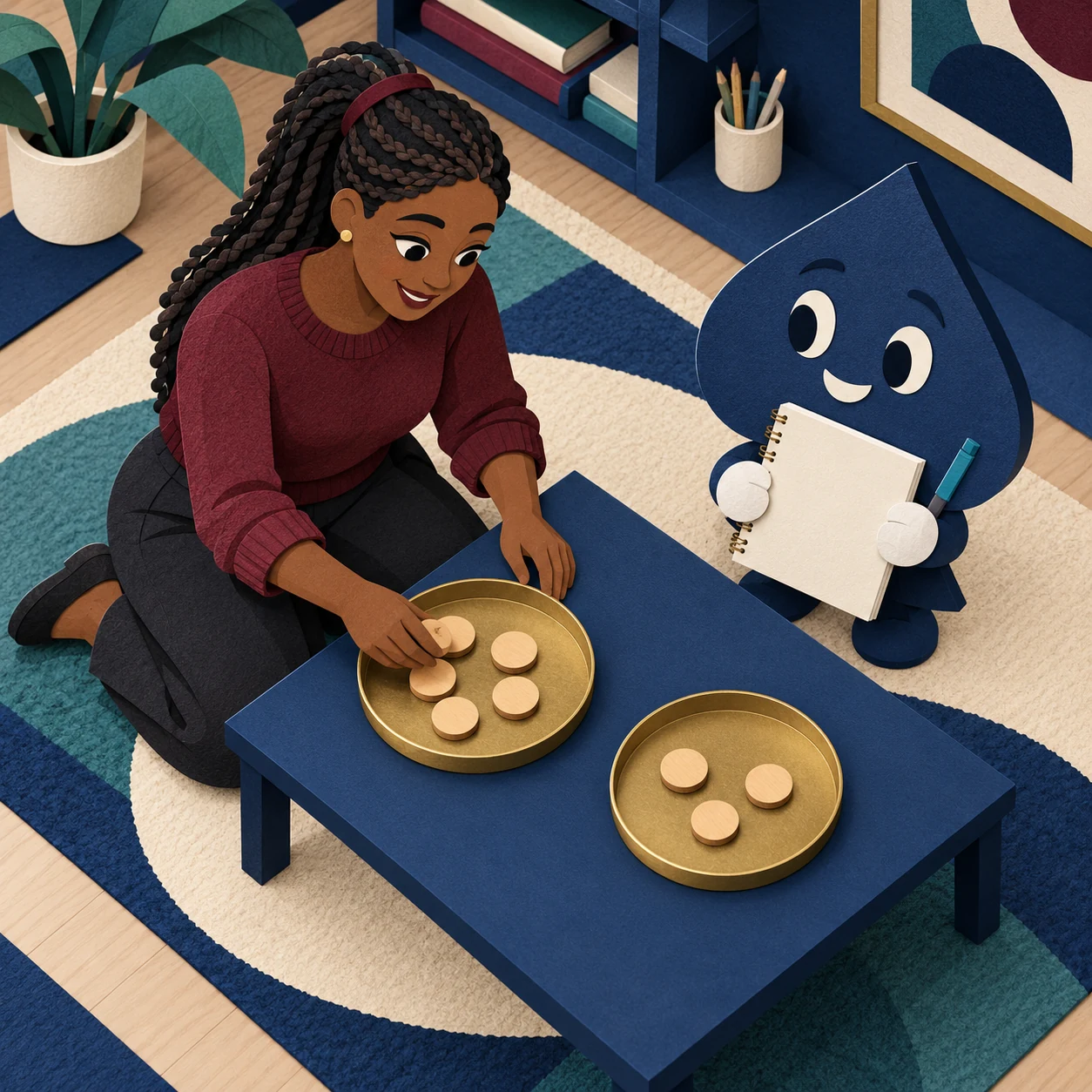
Write 120 as 60 for Omaha plus 60 for draw. A tie divides only the half that tied. It does not automatically halve every player’s final return.
Keep a separate line for each award until you have settled both. Then add each player’s two returns.
| Omaha result | Draw result | A receives | B receives |
|---|---|---|---|
| A wins | B wins | 60 | 60 |
| A wins | A wins | 120 | 0 |
| Tie | A wins | 30 + 60 = 90 | 30 |
| A wins | Tie | 60 + 30 = 90 | 30 |
| Tie | Tie | 30 + 30 = 60 | 30 + 30 = 60 |
The three-quarter result can look like a small win if you notice only the tie. It is a 90-chip return from a 120-chip pot. That number is a gross award, not a 90-chip profit. To find profit, subtract the chips A contributed. If A put in 50, the net is 40. If A put in 100, the same 90-chip award is a net loss of 10.
The calculator deliberately refuses 121 chips. A real table needs its own rule for odd chips, including which half receives an indivisible chip and how a tie is settled. It also needs separate pots when players are all-in for different amounts. Rounding a 30.25-chip award down twice would lose a chip; guessing where it belongs would teach a house rule we have not selected.
Keep these names separate
- Plain Drawmaha high
The high/high, one-draw game used throughout this page.
- Sviten Special
Under SwC’s stated rule, drawing exactly one card reveals the replacement face up. You may keep it or reject it for one final face-down card, which you must accept. Do not silently add this option to ordinary Drawmaha.
- Drawmaha 2-7
The draw award becomes 2-7 lowball. The Omaha award remains high. This page’s high-hand draw evaluator would give the wrong objective.
- Drawmadugi
The draw award uses Badugi evaluation instead of a five-card high hand. It needs a different evaluator.
A bomb pot is a separate dealing arrangement. The ordinary deal taught here has blinds and preflop betting. The word Drawmaha alone does not authorize skipping that round. Ask what the table actually plays before importing a bomb-pot procedure.
Five things to settle before a real deal
- Read the full game name and choose the draw ranking: high, 2-7 or Badugi.
- Confirm the betting structure and the position of the draw.
- Check whether the one-card exchange has a face-up Sviten option.
- Ask for the dealer’s reshuffle and exhausted-deck procedure. Do not assume you can receive, or cannot receive, your own discarded card.
- Confirm odd-chip and side-pot rules before a disputed pot makes them urgent.
This lesson does not establish that any particular app, club or table currently offers Drawmaha. It also makes no claim about a client’s discard protection, hand-history display or player traffic. Those are product questions that need that operator’s current evidence.
For a final self-check, take the three-quarter preset and change the pot to 200. The tied Omaha half gives each player 50; A then wins the 100-chip draw half. The totals must be A 150 and B 50. If your answer is 100 each, you split the whole pot before deciding who won the second award.