Five-Card Draw rules: deal, exchange, compare
Five-Card Draw gives you a private hand, a chance to replace cards and a final decision about whether to continue. There is no board to rescue a missed draw. The finished hand is the five cards you actually hold after the exchange.
June has pulled up a chair, and the HPD spade has brought an empty discard tray. Work through the sample hand with them, then try the six card problems. You can do the whole lesson with paper and an ordinary deck, without placing a wager.
Choose your way through the lesson
Hosting a practice game? Start with the host’s rules sheet, then use the complete hand to rehearse the order aloud. Already sitting down as a player? Begin with the player’s sequence and stop at the draw decision before looking at the results.
Both routes meet at hand comparison. If you know the procedure and want a check, go straight to the six scenarios. The record-review checklist is there for your own practice notes afterward. These are ordinary page links; choosing a route does not hide the other sections.
For the host: write down the game before dealing
This lesson uses the button-and-blinds, one-draw high profile described in PokerStars’ Five Card Draw rules. Each player receives five private cards. There is betting before the draw and after it. The opening action starts with the first active player left of the big blind; post-draw betting starts with the first active player left of the button. Action moves clockwise. At showdown, traditional high hands compete, with equal hands sharing the pot.
That profile allows a player to exchange up to five cards. Keeping every card is also permitted. We use an ordinary 52-card deck without jokers or wild cards for all examples. The exercises have enough undealt cards for their replacements, so none requires a deck reshuffle.
Write the chosen betting structure separately. A game name alone does not specify every permitted bet size. For a paper rehearsal, you can announce simple legal bet amounts in advance and concentrate on who acts when. In a real game, the written limit, minimum raise and all-in rules govern those decisions. Resolve them before anyone commits chips.
- Name the game precisely: one draw, high hands, five final private cards
- Record the blind amounts and identify the button before the first action
- State the discard range for this profile: zero through five
- Confirm whether any separate house rule changes the deck, opening requirement or draw procedure
- Have the room’s procedure ready for exposed cards, a wrong card count and an exhausted deck
Do not silently add a three-card discard cap, an exception for holding an ace, a joker or a requirement to open with jacks. None is part of the profile taught here. If a host wants a different rule, it needs an explicit explanation and agreement before the hand. A familiar family custom can still surprise somebody visiting the table.
For an exhausted deck, stop and consult the applicable procedure. Do not improvise by mixing every folded hand and discard together. Which cards may be reused, and when, is a separate dealing question. This lesson does not simulate that situation or tell a dealer how to repair it.
For the player: keep the hand in order
- Receive your private cards and check that there are five
- Complete the first betting round
- Choose your discards when the draw reaches you; take the same number of replacements
- Complete the second betting round with your final hand
- Compare surviving hands if a showdown is needed
Before the draw, the big blind creates an amount to match. A player facing a bet can fold, call or raise within the chosen betting rules. A call adds the difference between that player’s existing contribution and the required total. A raise changes that total and may bring action back to people who have already acted. Posting a blind does not mean a player has finished the betting round.
After the draw, a player who faces no bet may check or bet. Checking keeps the hand live; folding gives up its claim to the pot. If someone bets after you check, you may have another decision. A round is not necessarily finished just because every seat has spoken once. It must be closed under the betting rules.
If everyone else folds, the remaining player takes the pot without needing to prove a particular hand strength. The draw or showdown is skipped when the hand has already ended. Do not deal replacements merely because they appear next in your rehearsal notes.
Use “before the draw” and “after the draw” in your first notes. They are harder to misread than calling the exchange a flop. Someone who learned community-card poker may automatically wait for a turn or river. Here, once the exchange is complete, the final betting round is the last decision stage.
At the draw: count what leaves, then what arrives
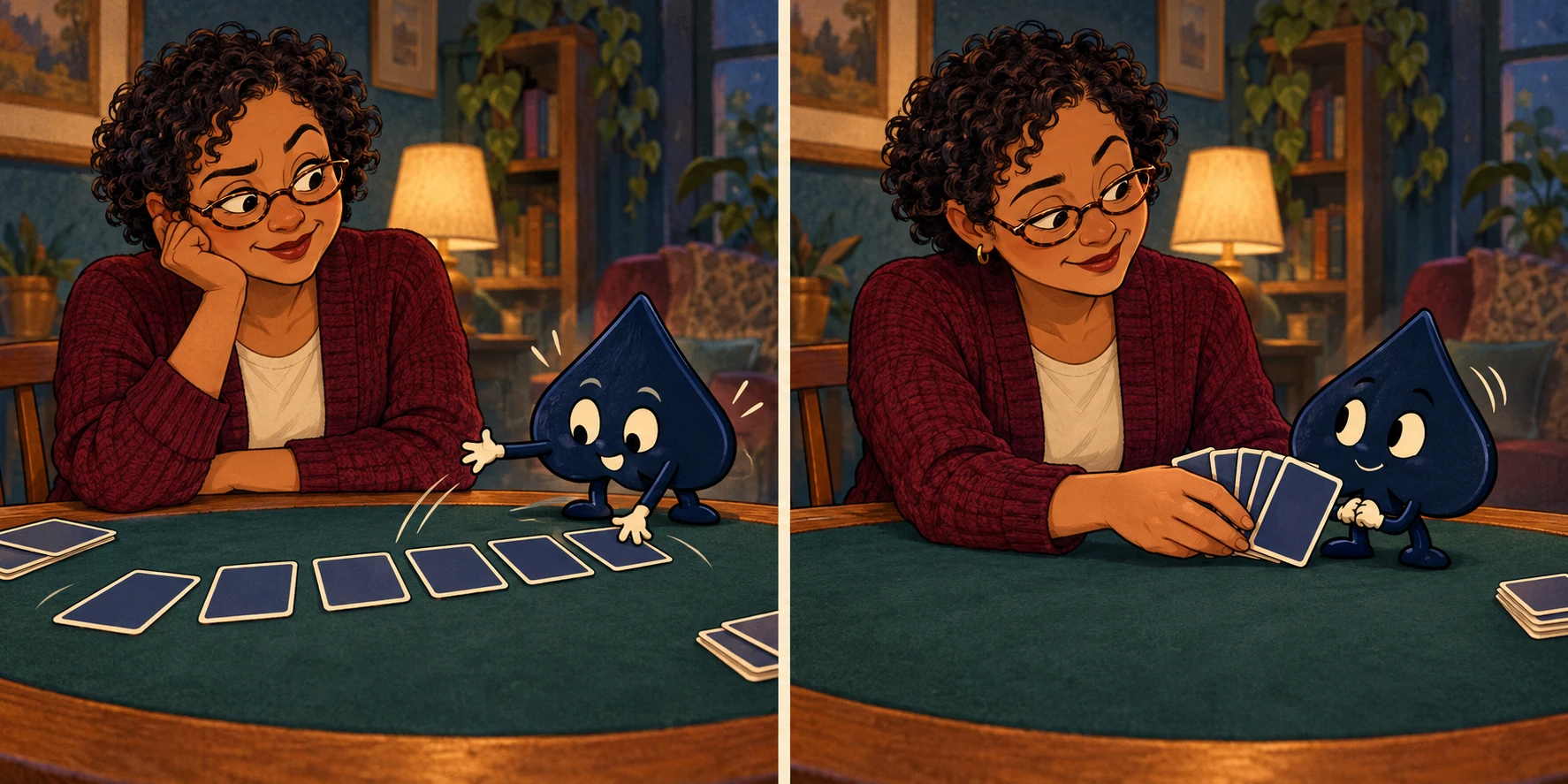
Standing pat means discarding zero cards and receiving zero replacements. It says what a player did, not what they hold. A pat player has not shown a straight, flush or full house merely by declining the exchange. Record “stood pat” as an observation. Save any guess about hand strength for a separate note.
For an exchange, identify the cards you intend to keep before moving the discards. If you keep two, three leave and three arrive. Keeping one means replacing four. Replacing all five gives you a completely new hand, but it still uses the single draw; you cannot inspect those replacements and request another exchange.
Your final hand consists of the retained cards plus the replacements. A discarded ace cannot return as an extra kicker in your showdown description. If your notes appear to produce six or seven usable cards, reconstruct the exchange before evaluating anything. A small bookkeeping mistake can turn a losing hand into an imaginary winner.
Card selection and hand evaluation answer different questions. A worked draw can show the legal result of an exchange without proving that the discard choice was the best decision. The examples below deliberately include both improvement and disappointment. Treat the replacements as stated facts of those practice hands, not as predictions.
Compare all five cards in the right order
Use the strongest category present in the final five. A higher category wins before you compare the ranks inside it. A royal flush is the ace-high straight flush, at the top of the same straight-flush family. The table lists that family once.
| Category | What decides between hands of that category |
|---|---|
| Straight flush | Top of the sequence |
| Four of a kind | Rank of the four; then the remaining card |
| Full house | Rank of the three; then the pair |
| Flush | Ranks from highest downward |
| Straight | Top of the sequence |
| Three of a kind | Rank of the three; then remaining cards downward |
| Two pair | Higher pair, lower pair, then kicker |
| One pair | Pair rank, then the three kickers downward |
| High card | All five ranks from highest downward |
An ace can finish a ten-to-ace straight or begin an ace-to-five straight. In the latter, the hand is five-high. It cannot join a king to a two to make a wraparound straight. Straights have no spare kicker because every card is part of the sequence.
Suits identify cards and can make a flush, but they do not break a showdown tie. If the category and every comparison rank agree, the hands tie. In a five-card private-hand game, do not borrow a sixth card from a discard tray, an opponent or your earlier holding to settle that tie.
The phrase “best five” can be misleading if you learned five-card Omaha first. In this lesson, you do not choose two private cards and add three from a board. You simply evaluate the final five private cards. The five in both game names is a poor shortcut for remembering their rules.
A complete hand, including the chips
Here is a four-seat paper rehearsal. Going clockwise, the seats are June on the button, Ari in the small blind, Bo in the big blind and Cam. Blinds are 1 and 2 practice chips. Each player starts with 100. Use a no-limit rehearsal in which the stated bets are legal; there are no antes, fees, side pots or all-ins.
Cam acts first and raises to 6. June calls 6. Ari folds the small blind. Bo already has 2 in the pot and adds 4 to call. The first round closes. Cam and June each contributed 6, Bo contributed 6, and Ari contributed 1, so the pot is 19. A raise to 6 is a total contribution of 6 for that round, not an extra 6 on top of the blind.
| Player | Original cards | Discards | Replacements | Final cards |
|---|---|---|---|---|
| Bo | 8♠ 8♦ K♥ 5♠ 7♦ | 5♠ 7♦ | 8♣ 4♥ | 8♠ 8♦ 8♣ K♥ 4♥ |
| Cam | A♣ J♣ 9♣ 6♣ 3♠ | 3♠ | 2♣ | A♣ J♣ 9♣ 6♣ 2♣ |
| June | Q♠ Q♥ 10♦ 10♠ 7♣ | 7♣ | 3♦ | Q♠ Q♥ 10♦ 10♠ 3♦ |
Bo receives two replacements. Cam and June receive one each. Everyone has five cards again. For a tabletop rehearsal, keep the discarded cards separate from the live hands so you can inspect the record afterward. The exact replacements are supplied for teaching; no one is choosing cards out of the undealt deck.
Ari has folded, so Bo is the first active player left of the button for the final betting round. Bo checks. Cam bets 8. June folds. Bo calls 8. This adds 16 to the existing 19, making a 35-chip pot. Bo shows three eights; Cam shows an ace-high club flush. Cam wins because a flush outranks three of a kind. June’s two pair is no longer eligible after the fold.
| Player | Before draw | After draw | Total contributed |
|---|---|---|---|
| Ari | 1 | 0 | 1 |
| Bo | 6 | 8 | 14 |
| Cam | 6 | 8 | 14 |
| June | 6 | 0 | 6 |
| Total | 19 | 16 | 35 |
Do the count before reading a player’s story about the hand. Cam receives 35 chips, but 14 of those came from Cam’s own stack. The pot received and the change in a player’s stack are different quantities. The final stacks are Ari 99, Bo 86, June 94 and Cam 121; they still total the original 400.
Now change only one decision in your rehearsal. Suppose Bo folds to Cam’s final bet instead of calling. Cam is the only remaining player, so there is no contested showdown. The uncalled 8 is returned and the contested pot is the earlier 19. This is a useful way to catch the habit of counting a player’s uncalled chips as winnings from an opponent.
Six exact-card scenarios
Read each table as a separate hand. A, K, Q and J mean ace, king, queen and jack; ♠, ♥, ♦ and ♣ mean spades, hearts, diamonds and clubs. Identify the exchange count, the final five and the decisive comparison. Open the answer only after you have said why. With a keyboard, Tab reaches each answer and Enter or Space opens it. The answers work without JavaScript.
1. The empty discard tray
Nora keeps her entire hand. Lee has completed the draw and reaches showdown against her. How many replacements does Nora receive, and who wins?
| Player | Final cards | Recorded draw |
|---|---|---|
| Nora | A♥ J♥ 9♥ 6♥ 2♥ | Stood pat |
| Lee | Q♠ Q♦ Q♣ 8♠ 4♦ | One card |
Check scenario 1
Nora receives zero replacement cards and wins with an ace-high flush. Lee has three queens. The category comparison settles it; Lee’s three matching cards do not outrank five hearts.
Keeping the hand did not make it stronger. It preserved the same five cards. If you are reviewing a real record, a zero-card draw alone would not tell you Nora had this flush; you know it here because her final cards are explicitly shown.
2. The discarded ace stays discarded
Sam keeps the pair of eights and exchanges three cards. Compare the completed hand with Tess. Can Sam use the old ace as a kicker?
| Record | Cards |
|---|---|
| Sam before draw | 8♠ 8♦ A♠ J♣ 2♥ |
| Sam discards | A♠ J♣ 2♥ |
| Sam receives | 8♣ K♦ 4♠ |
| Sam at showdown | 8♠ 8♦ 8♣ K♦ 4♠ |
| Tess at showdown | 7♠ 7♦ 7♥ A♣ Q♣ |
Check scenario 2
Sam wins with three eights against three sevens. The trip rank decides before either player’s kickers. Tess’s ace does not overcome the lower three of a kind.
Sam exchanged three and received three. The live kickers are K♦ and 4♠; A♠ is no longer in the hand. Saying “three eights with an ace” would describe cards Sam does not hold, even though that particular error would not change this winner.
3. A fresh five is still one draw
Pia discards the whole original hand under this lesson’s stated rules. Her replacement hand looks much better. Does it beat Owen, and may she draw again?
| Record | Cards |
|---|---|
| Pia before draw | 2♣ 5♦ 7♥ 9♠ J♦ |
| Pia discards | 2♣ 5♦ 7♥ 9♠ J♦ |
| Pia receives and holds | K♠ K♥ 6♣ 6♦ A♣ |
| Owen at showdown | Q♠ Q♦ Q♣ 8♥ 3♠ |
Check scenario 3
Pia’s five-card exchange is legal in the named profile. The result is kings and sixes with an ace kicker. Owen wins with three queens because three of a kind beats two pair.
Pia has used the only draw. She cannot keep the new kings and ask for another exchange in this hand. Improvement relative to her first hand is real, but showdown compares her final hand with Owen’s final hand, not with her own starting point.
4. The ace is at the low end
Both players say “straight.” Put each sequence in order and decide whether the ace makes Luis’s hand higher.
| Player | Final cards |
|---|---|
| Luis | A♠ 2♦ 3♣ 4♥ 5♠ |
| Mina | 2♥ 3♦ 4♣ 5♥ 6♠ |
Check scenario 4
Mina wins with a six-high straight. Luis has the wheel, a five-high straight. In Luis’s sequence the ace plays below the two, so it is not an ace-high hand and cannot act as an extra kicker.
Read them as 5-4-3-2-A and 6-5-4-3-2. Comparing the top of the completed sequence makes the result clear. This high-hand result is why you must know the ranking system before borrowing advice from a lowball game.
5. Two matching ranks are not the end
Iris and Max both show ace-high flushes, and both have a jack next. Which card settles it? Would a higher suit break the tie?
| Player | Final cards |
|---|---|
| Iris | A♠ J♠ 9♠ 6♠ 2♠ |
| Max | A♥ J♥ 8♥ 7♥ 3♥ |
Check scenario 5
Iris wins at the third comparison rank: nine beats eight. The ace and jack match, so you continue downward. Max’s seven and three cannot repair the earlier loss at nine versus eight.
Spades do not beat hearts by suit priority. Iris would still win this comparison if the same rank patterns appeared in the opposite suits. Stop at the first unequal comparison rank; do not add card values or vote on which hand has more attractive small cards.
6. There is no sixth-card tiebreaker
The final pot is 90 practice chips, with no fees or side pots. Compare all five ranks. Does either player take more because of a suit?
| Player | Final cards |
|---|---|
| Dev | 10♠ 10♥ A♦ Q♣ 7♠ |
| Rae | 10♦ 10♣ A♥ Q♦ 7♥ |
Check scenario 6
The hands tie: one pair of tens, then ace, queen and seven. Dev and Rae each receive 45 of the 90 chips. All five comparison ranks agree, and suits do not award either player an extra share.
There is no unused private card to consult because these are five-card hands. Earlier discards are irrelevant. If your written result says “Dev wins with the spade,” repair the comparison rather than trying to invent a sixth tiebreak.
Review a record you can actually explain

Use these checkboxes against one completed practice hand. Tick a box only when you can point to the corresponding fact in your notes. A tick is your own mark, not an automatic judgment of the hand. If something is missing, leave it unticked and write what you need to find.
Click a label or use Tab to focus its checkbox and Space to toggle it. These are ordinary browser checkboxes with no submission or scoring. Keep any lasting review notes in your own notebook. The exercise does not need a login, an account balance or a hand-history upload.
Give an error a narrow name. “I counted a discarded ace” tells you exactly what to inspect next time. “I forgot the second betting round” is an order problem. “I called every ace-high flush a tie” is a comparison problem. Separating those mistakes makes the next practice hand easier to review.
A good short rehearsal is to replay the complete hand once without looking at the chip table, then revisit whichever scenario caught you. The HPD poker study routine has a broader way to organize that kind of focused review. You do not need to grind through all six questions every time.
Keep the game label with the record
A draw describes an exchange mechanism. It does not by itself tell you which hand wins. This page uses traditional high ranking. In Badugi, the target hand and the ranking test are different. Keep the full game name on your notes so an answer from one lesson does not become a rule in another.
You can return to the HPD info and tools library when you want another rules exercise. For this hand, leave one useful record behind: what you started with, what you exchanged, what you ended with, and why that final hand won or lost.