Double-board bomb pot rules: read both boards, split each pot
You make a full house on the top board. The bottom board looks useless. Before counting the whole pot as yours, stop: in a high-only double-board bomb pot, each board normally decides half of every pot you can win. A tie can reduce your share again.
A bomb pot starts with an agreed contribution from each participant and skips preflop betting. The double-board part adds a second, separate set of community cards. Nia and the HPD spade use no-cash practice chips below to show where the bets go, how Omaha differs from Hold’em, and why the biggest stack does not automatically contest every chip.

Start with the rule profile, follow the exact-card showdown, or try the split-pot trainer. The trainer includes ties, three separate pots, folded contributions and odd chips.
Agree on the game before posting
“Bomb pot” does not specify the number of hole cards, the betting limit or whether low hands receive anything. This lesson’s main profile is four-card pot-limit Omaha, high only, with two boards. The Hold’em exercises are labeled separately. Five- and six-card Omaha are other possible profiles; they give you more private cards, but a legal Omaha hand still uses exactly two.
- Four players each post a 5-chip ante before receiving cards. Our practice hand has no additional blinds. Everyone has enough to post the full ante.
- Each player receives four hole cards. There is no preflop check, raise or fold decision in this practice sequence. Both three-card flops appear before the first betting round.
- There is one betting round on the flop, one on the turn and one on the river. A bet contests both boards; it is not a separate top-board bet.
- Each board awards the high hand only. There is no low qualifier or low half. A player may use a different pair of hole cards on each board.
- Our practice opening minimum is 5 chips. Pot-limit caps the maximum. The actual room sets its own ante, minimum and dealing procedures.
At a real table, establish participation before the deal. Some games schedule mandatory bomb pots; others offer them by agreement. Ask how opting out, sitting out and short antes work. “Forced contribution” describes the posted cost of the selected hand. It does not establish a universal right to skip it, or an obligation to join every home-game proposal.
Cadence varies too. A room may use a scheduled hand, a dealer change or a random trigger. Button movement, burn-card procedure, rake and the treatment of a player unable to post the whole ante need the room’s rules. None of those details follows merely from seeing two boards.
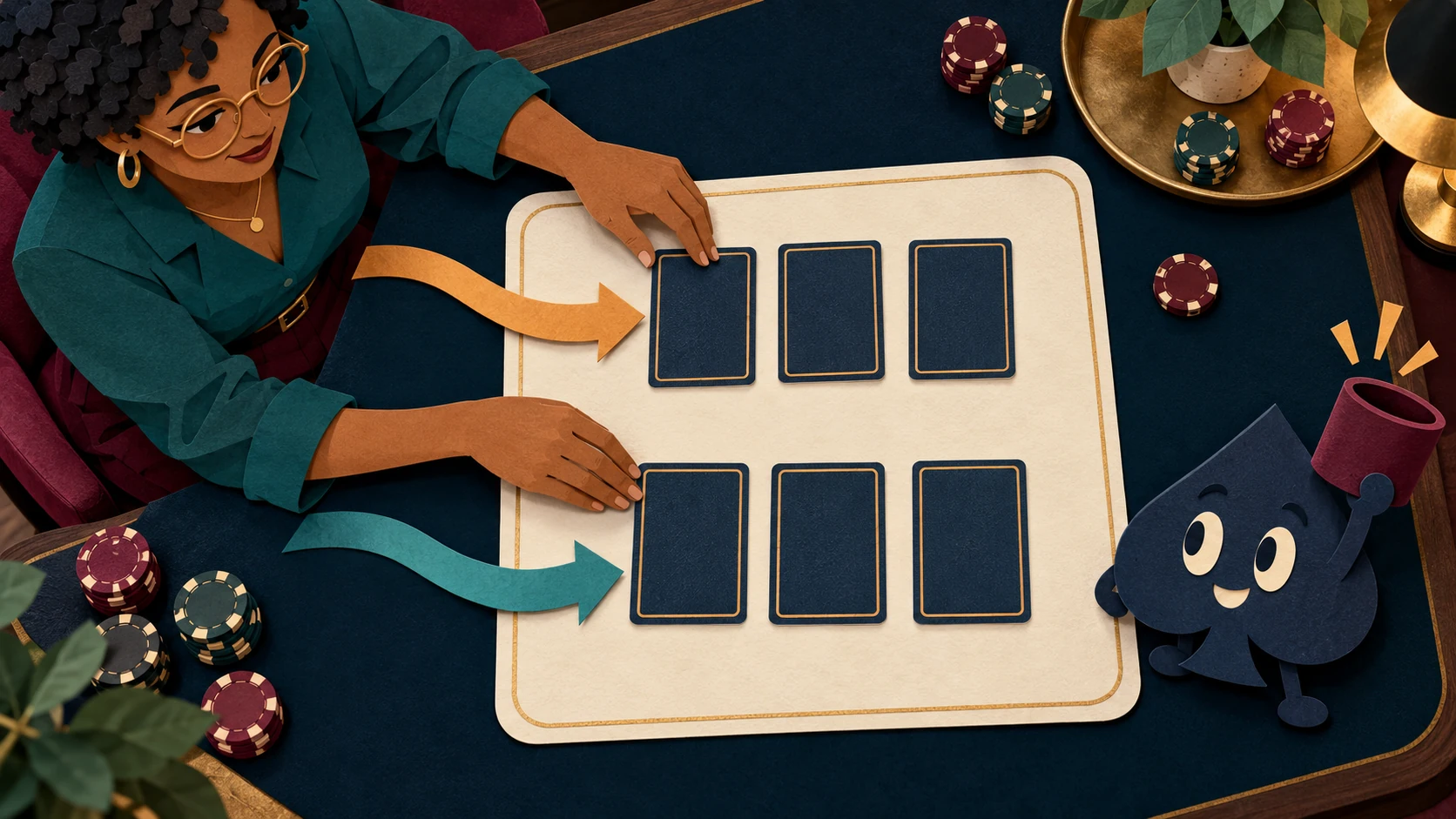
One betting sequence, two visible boards
| Step | What happens in this practice profile |
|---|---|
| Entry | Four antes of 5 make a 20-chip starting pot; each player receives four hole cards. |
| Flop | Deal three cards to the top board and three to the bottom. The first live player left of the button acts first. |
| Turn | After flop betting finishes, add one card to each board. Start the next betting round with the first live player left of the button. |
| River | After turn betting finishes, add the final card to each board and hold the last betting round. |
| Showdown | Make a legal five-card hand for each board. Settle the main pot and every side pot using only eligible live hands. |
Checking leaves your hand in for both boards. Calling continues for both. Folding gives up your claim to both, and chips already called into the pot stay there. If everyone else folds, the remaining live hand takes the pot without needing to win a separate card contest on each board.
For a pot-limit sizing example, the untouched 20-chip flop pot permits an opening bet up to 20. After a 20-chip bet, the next player can call 20, making the pot 60, then raise by up to 60. That is 80 chips total from that player on the street. You count the shared pot; you do not halve it because there are two boards. This example assumes no earlier side pot, no rake deduction and stacks large enough for the action.
Omaha and Hold’em use the cards differently
| Rule | Four-card Omaha, high only | Hold’em, high only |
|---|---|---|
| Private cards | Four | Two |
| Cards used in the final hand | Exactly two private cards and exactly three cards from one board | Any best five from the two private cards and that board: zero, one or two private cards |
| Can the board itself be your hand? | No | Yes |
| Can you mix the two boards? | No | No |
In Omaha, a lone ace of hearts in your hand does not make a flush when four hearts appear on a board. You need two hearts in your private cards and three hearts on that same board. Nor can you take two cards from the top board and one from the bottom. Each board is a separate five-card problem.
A different hole-card pair may be best on the other board. Keep all four cards available until both hands have been read. The card count is a rule, not a preference: a stronger-looking six-card combination cannot replace a legal five-card hand.

Work a complete two-board showdown
All four players have contributed 50 chips in total, including their antes. The 200-chip pot has no side pot and no rake. These are four-card Omaha hands; all exact card faces are written below.
| Player | Hole cards |
|---|---|
| Ari | A♠ A♦ 9♣ 8♣ |
| Bo | K♥ K♦ 7♠ 6♠ |
| Cy | Q♣ Q♦ J♣ 6♥ |
| Dev | 5♣ 5♦ 7♥ 6♦ |
Top board: A♥ K♠ 2♣ 2♦ 3♠
Bottom board: K♣ Q♥ 9♦ 8♥ 4♣
Ari wins the top board with A♠ A♦ A♥ 2♣ 2♦, aces full of twos. Bo has kings full of twos there. On the bottom, Bo uses K♥ K♦ K♣ Q♥ 9♦ for three kings. Cy’s three queens lose to those kings, while Ari’s best bottom hand is two pair, nines and eights.
Ari receives 100 and Bo receives 100. Cy and Dev receive zero. Receiving half the pot is not the same as breaking even: Ari and Bo each put in 50, so each finishes 50 ahead in this four-player example.
The same cards can settle three different pots
Keep those Omaha cards. Change the total contributions to Ari 40, Bo 100, Cy 160 and Dev 220. Ari, Bo and Cy have reached their respective all-in caps. Dev’s final 60 has no matching contribution and comes back before any board split. The remaining 460 is three pots, not one pot shared among four players.
| Pot | How it is built | Eligible live hands | Top award | Bottom award |
|---|---|---|---|---|
| Main: 160 | 40 × 4 | Ari, Bo, Cy, Dev | Ari 80 | Bo 80 |
| Side 1: 180 | (100 − 40) × 3 | Bo, Cy, Dev | Bo 90 | Bo 90 |
| Side 2: 120 | (160 − 100) × 2 | Cy, Dev | Cy 60 | Cy 60 |
Bo loses the top-board main pot to Ari, but wins that board’s first side-pot share because Ari is not eligible for it. Cy wins both shares of the final side pot because Bo is also capped out. A hand can lose the main pot and still win a side pot on the very same board.
Final awards are Ari 80, Bo 260 and Cy 120. Dev receives the 60-chip uncalled return. The check is 520 contributed = 460 awarded + 60 returned. Dev’s return is not a board win. Net results are +40, +160, −40 and −160 respectively, which add to zero.

Now suppose Dev folded after contributing 100, while Cy pushed 160. Dev’s 100 remains available to eligible opponents. Cy gets the uncalled 60 back. The main pot is still 160, and the only side pot is 180. Ari wins 80; Bo wins 260. Dev cannot win either board after folding. The trainer’s folded-chips exercise lets you inspect this version.
A quarter of the pot does not require a low hand
Switch to Hold’em for this 200-chip example. Ari holds A♠ 9♦ and Bo holds A♥ 8♦. Cy has 7♣ 7♦; Dev has 4♣ 4♦. Each player contributed 50.
Top: A♣ K♣ K♥ Q♣ 2♦. Ari and Bo both make aces and kings with a queen kicker. Ari’s nine and Bo’s eight do not play in that five-card hand. They split the 100-chip top share, receiving 50 each.
Bottom: 9♣ 9♥ 6♠ 5♠ 3♦. Ari makes three nines and wins the 100-chip bottom share outright. Ari receives 150 overall; Bo receives 50. That is three quarters and one quarter of the pot, even though this is high-only poker.
Do not rank suits to break an equal poker hand. If three players tie a board, each receives one third of that board’s share before any indivisible-chip procedure. In an even two-board pot, that can be one sixth of the full pot. With side pots, name the particular pot before describing someone’s fraction.
Odd chips need an agreed procedure
There are two separate rounding questions: which board receives a chip that cannot be divided between the boards, and which tied player receives a chip that cannot be divided within one board’s share. Ask both. A top-board-first convention exists in some published room rules, but it is not a universal poker rule.
The trainer starts with a declared practice convention: give an odd pot chip to the top board, then distribute any remainder within a tied board share in the displayed seat-priority order. You can switch the first choice to bottom and rotate the priority. These controls illustrate an agreed procedure; they do not identify your room’s rule.
Use the Hold’em cards above with Ari, Bo and Cy contributing 25 each and Dev out. With 75 chips and top-first rounding, the top gets 38, split 19 each between Ari and Bo. Ari also wins the bottom’s 37, for 56 total; Bo gets 19. With bottom-first rounding and Ari first in tie priority, the top’s 37 splits 19 to Ari and 18 to Bo, while the bottom pays Ari 38. Ari then gets 57 and Bo 18. Both conserve all 75 chips.
Try the split-pot trainer
Choose a completed practice deal, predict the result, then split the pots. You can change total contributions and mark hands folded. Amounts include the ante and all later contributions, in whole units of the smallest chip. Zero means no contribution and no pot eligibility. Changing a number creates a synthetic settlement exercise; the tool does not prove that a betting sequence was legal.
This is a high-only showdown and accounting trainer. It has no live odds, no betting advice, no rake deduction and no Hi/Lo split. It does not decide short-ante disputes, fouled decks or mucked-hand rulings. Use it away from live play. Nothing is sent or saved.
Practice answer key, available without JavaScript
- PLO, one board each: Ari 100; Bo 100; Cy 0; Dev 0. Total 200.
- PLO, three pots: Ari 80; Bo 260; Cy 120; Dev 0 awarded and 60 returned. Total 520.
- Hold’em, a quarter: Ari 150; Bo 50; Cy 0; Dev 0. Total 200.
- Hold’em, 75 chips, top-first: Ari 56; Bo 19. Bottom-first with Ari first: Ari 57; Bo 18. Bottom-first with Bo first: Ari 56; Bo 19.
- PLO, folded chips: Ari 80; Bo 260; Cy 0 awarded and 60 returned; Dev 0. Total 400.
- PLO, scoop: Ari wins all 200. On the changed bottom board, 9♦ 9♥ 8♥ 4♣ 2♥, Ari uses 9♣ 8♣ with 9♦ 9♥ 8♥ for nines full of eights.
A strong top board is only part of the decision

Suppose two players remain and each is certain to win one board. Ignore ties, rake and future changes. If each adds 100, the pot grows by 200, but each player’s eventual half grows by only 100. Neither earns extra profit from that matched exchange. Adding chips is not automatically valuable just because your hand is unbeatable on one board.
With several opponents, a capped player, possible redraws or uncertain winners, the calculation changes. Check the share you can actually win and the opponents eligible for it. A draw toward one half may leave you paying for a contest on both boards. The examples here explain settlement; they cannot tell you whether a live call is profitable.
Questions to settle before the first bomb pot
- Which game is it: Hold’em, four-card Omaha, five-card Omaha or another named variant? Is every board high only?
- How much does each participant post, who must take part, and what happens if a player has less than the ante?
- When does the bomb pot occur, which button is used, and how are boards and burns dealt?
- What are the betting limit and minimum opening bet? How are side pots, rake and uncalled chips handled?
- Which board receives an odd chip, and how are remainder chips assigned when a board ties?
Double board, bomb pot or run it twice?
Ordinary double-board poker can retain preflop betting. A bomb pot skips that betting round after the agreed forced entry. Combining them gives the format in this lesson. Seeing two boards on a screen is therefore not enough to identify a bomb pot.
Running it twice usually begins when betting is already finished, often after an all-in. The remaining board cards are dealt more than once under the room’s procedure to divide the existing pot. In a double-board bomb pot, both flops are present while betting decisions can still be made. Shared early cards and eligible runouts in a run-it-twice hand also depend on its rules.
High-only double-board Omaha has no automatic low award. If you want the separate eight-or-better split, read the Omaha Hi/Lo lesson. For five private cards with a qualifying low, see Big O rules. The HPD rules and tools index has the other game profiles.
At showdown, keep your cards visible and read each eligible pot twice: once against the top board and once against the bottom. Return unmatched chips, apply the agreed tie procedure, then make the totals reconcile before the next hand begins.