PLO4 rules and legal hand construction
Four private cards can make the table look generous. Your finished hand still has five cards, and only two of them may come from your hand. That is the rule to settle before you start naming a flush, straight or full house. In ordinary four-card Omaha high, use exactly two of your four hole cards and exactly three community cards. The other cards remain visible information, but they do not belong to the five-card hand you are comparing.
This lesson covers standard 52-card, single-board PLO4 high. The exercises use a completed five-card board. You can build a strongest legal high hand, then optionally compare it with a known opponent hand. Work through the examples with paper and a deck if you prefer.
Legal-hand drill Flush examples Board traps Recall hand

Read the game name in separate parts
The four in PLO4 tells you how many private cards you receive. Omaha tells you how to construct your hand. Pot-limit tells you how much you may wager. Changing the betting structure does not allow a third private card to enter your final hand. PokerStars’ Omaha rules and the 2026 WSOP tournament rules both require two private cards and three board cards.
Ordinary Omaha high awards the relevant pot to the best high hand among eligible players. Omaha Hi/Lo has a separate qualifying low side. An eight-or-better low needs five different ranks of eight or lower, and high and low can use different legal combinations. The Hi/Lo rules cover that variation. The exercise here evaluates high hands. An ace and a deuce do not create a low prize in a high-only game.
Count the sources before ranking the hand
Use a two-pass check. First, point to two private cards and three board cards. Count them aloud if that helps. Second, rank those five cards. Reversing that order is how an attractive but illegal hand slips through. A five-card flush is no use if four of its cards came from the board.
You have six possible private-card pairs. Label the four cards A, B, C and D; the pairs are AB, AC, AD, BC, BD and CD. On the river there are ten possible three-card board groups. Combining each pair with each board group produces sixty legal candidate selections. You do not need to list all sixty at the table, but this gives us a complete way to check an exercise rather than trusting the first combination that looks good.
On the flop, all three board cards must be used because only three are available. On the turn, you choose three of the four board cards. The private-card requirement stays at two on every street where a five-card hand can be formed. Before the flop, there is no completed five-card hand to evaluate from private cards and board cards alone.
The exercise first checks the number and source of your selected cards. If the selection is legal, it compares that hand with all sixty candidates. A legal selection can still be weaker than another legal selection. When several selections have the same best rank, any of them is accepted; card suits do not break a tie between otherwise identical standard high hands.
Choose the five cards that count
These fictional river hands use four-card Omaha high rules. Select two private cards and three board cards, then check whether your five-card hand is the best legal one. Different selections can tie for best.
The interactive exercise needs JavaScript. The worked hands and answers below remain available.
Read the six practice answers
One heart. A♥ K♣ Q♦ J♠ on K♥ 9♥ 6♥ 2♥ 3♣ makes one pair. Use A♥ K♣ with K♥ 9♥ 6♥ for kings with ace, nine and six kickers. One heart cannot make a flush.
Board straight. A♥ A♦ K♣ Q♣ on 2♣ 3♦ 4♥ 5♠ 6♣ makes a pair of aces with six, five and four. You cannot play all five board cards.
Wheel. A♠ 2♦ K♥ Q♥ on 3♣ 4♠ 5♦ J♣ 9♥ makes a five-high straight using A♠ 2♦ and 3♣ 4♠ 5♦.
Full house. A♠ A♦ K♣ Q♣ on A♥ 7♦ 7♣ 2♠ 3♥ makes aces full of sevens using A♠ A♦ and A♥ 7♦ 7♣.
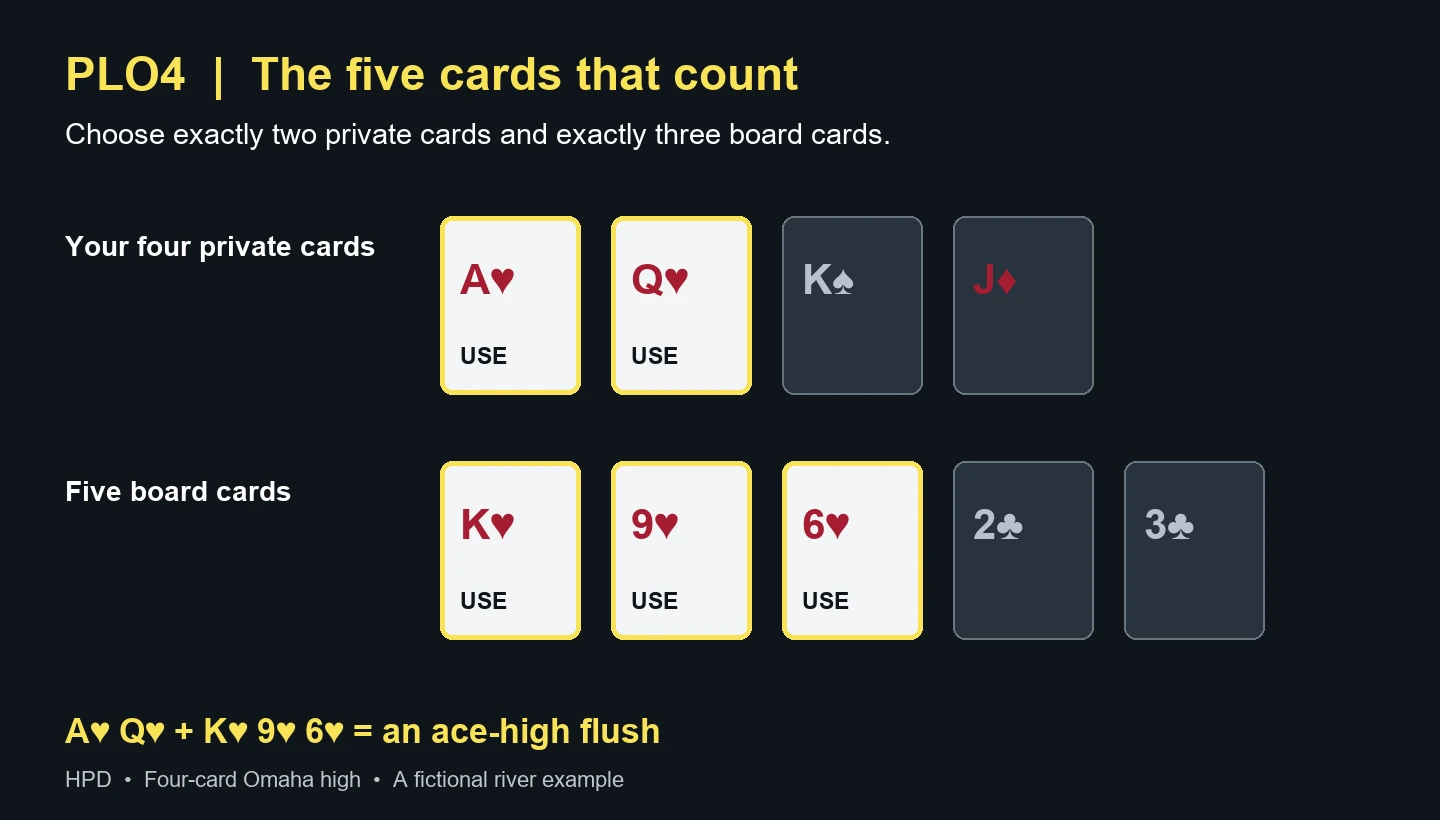
Two hearts. A♥ Q♥ K♠ J♦ on K♥ 9♥ 6♥ 2♣ 3♣ makes an ace-high flush using A♥ Q♥ and K♥ 9♥ 6♥.
Kickers. A♠ K♦ 9♣ 8♣ on Q♥ Q♦ 7♠ 4♥ 2♣ makes queens with ace, king and seven using A♠ K♦ and Q♥ Q♦ 7♠.
Check a river hand of your own
Enter space-separated codes. Ranks are 2–9, T (or 10), J, Q, K and A. Suits are s, h, d and c. Example: Ah Qh Ks Jd. Use a complete board. The optional opponent hand compares high hands only; this tool does not calculate equity, low hands, betting decisions or side-pot eligibility.
A single heart does not make an Omaha flush
Take A of hearts, K of clubs, 9 of diamonds and 8 of spades as your private cards. The board is K of hearts, Q of hearts, 7 of hearts, 4 of hearts and 2 of clubs. It is tempting to put the ace beside the four board hearts. That uses one private card and four board cards, so it fails the construction rule before hand strength is considered.
A strongest legal selection is A of hearts and K of clubs with K of hearts, Q of hearts and 7 of hearts. It is one pair, kings, with ace, queen and seven kickers. The ace of hearts is useful in that selection as a high kicker. Its suit does not rescue the missing second private heart. Check the actual five selected cards rather than the total number of hearts somewhere on the screen.
Now change the private cards to A of hearts, 8 of hearts, K of clubs and 9 of diamonds. Use a board of K of hearts, Q of hearts, 7 of hearts, 4 of spades and 2 of clubs. The ace and eight can combine with the three board hearts for an ace-high flush. Here the source counts work. Four hearts among your private cards would still contribute only two hearts; you also need three hearts on the board.
The board cannot play by itself
Suppose the board is 5 of clubs, 6 of hearts, 7 of spades, 8 of clubs and 9 of hearts. Your private cards are A of spades, A of diamonds, K of clubs and Q of diamonds. The board contains a straight, but you cannot submit all five board cards. Your strongest legal hand is a pair of aces with nine, eight and seven kickers.
To make a straight you need a private-card pair that fits with three board ranks into five consecutive ranks. None of your pairs does that here. Adding an ace to four board cards still has the wrong source counts. A royal flush on the board has the same restriction. You must use two private cards.
The opposite mistake is to assume a board straight means nobody can have a straight. Give a player an eight and a nine among their private cards, and they can combine those cards with a board five, six and seven. The result is a legal nine-high straight. The visible board pattern is a prompt to inspect combinations, not a substitute for that inspection.
Count repeated ranks carefully
A private hand of 7 of spades, 7 of hearts, 7 of diamonds and A of clubs looks almost complete when the board brings 7 of clubs. But you cannot use all three private sevens. On a board of 7 of clubs, K of diamonds, 9 of hearts, 4 of spades and 2 of diamonds, two private sevens plus the board seven, king and nine make three of a kind. There is no legal four-of-a-kind selection.
Three matching board cards cause a different trap. With A of hearts, A of clubs, A of diamonds, K of spades and 9 of clubs on the board, a player holding K of diamonds, Q of hearts, 7 of clubs and 2 of diamonds cannot use all three aces, the board king and the private king. That would require four board cards. Their best selection uses the private king and queen with the three board aces: three aces with king and queen kickers.
Change that private hand to K of diamonds, K of clubs, Q of hearts and 2 of diamonds. Now both private kings can join the three board aces. That is a legal full house, aces full of kings. The difference is the source of the second king. Naming the two private cards explicitly makes the distinction much easier to see than staring at all nine cards at once.
Kickers and identical high hands
Compare the category first, then its ranks. With a pair, compare the pair rank and then each kicker in descending order. On Q♥ Q♦ 7♠ 4♥ 2♣, A♠ K♦ 9♣ 8♣ and A♥ K♠ 6♣ 5♣ both make queens with ace, king and seven. Their unused cards do not break the tie. Suits do not rank against one another in standard high poker. See the high-hand comparison rules.
An ace can finish the lowest straight
With A of spades and 2 of diamonds among your private cards, a board containing 3 of clubs, 4 of hearts and 5 of spades can supply a legal five-high straight. Add K of clubs and Q of hearts to the private hand, and 9 of diamonds and 10 of clubs to the board; those extra cards do not improve the straight in this example. Choose the ace and deuce, then the three, four and five.
This straight is called a wheel. For high-hand comparison it is five-high, so it loses to a six-high straight. The ace cannot wrap around the rank order. Queen, king, ace, two and three is not a straight. A wheel remains a high-hand straight here.
Pot-limit changes the wager calculation
Here is a separate chip example with enough chips behind, no side pots and no deductions. There are 40 chips in the pot at the start of the betting round. An opponent bets 20, so 60 chips are now in the middle. You have not yet contributed on this round. Calling 20 would make the pot 80. You may then raise by up to 80, for a total contribution of 100 on the round.
The 100 consists of a 20-chip call and an 80-chip raise. It is not a 100-chip raise on top of the call. If no one had bet into the original 40-chip pot, the maximum opening bet would be 40. Actual table rulings also depend on available stacks, prior contributions and the applicable rules. Ask the dealer for the permitted pot-sized amount when unsure. This page’s card builder does not implement betting or side-pot calculations.
Once the bet is resolved, the hand-construction rule stays the same. An all-in player still uses two private cards and three board cards at showdown. For the chip calculation, use our pot-limit maximum raise lesson.
Return to the rule with different cards
Pause before the next exercise. Without looking back, say how many private cards and board cards belong in a finished Omaha hand. Then explain why a single private spade cannot make a flush from a four-spade board. You do not need to write an essay. One clear sentence that names both card sources is enough.
Try the separate recall hand below before revealing its answer. Then return to the practice selector and change the board pattern. There is no timer or saved score. You can come back with a physical deck and deal a new example.
Recall hand: can three private sevens make quads?
Your private cards are 7♠ 7♥ 7♦ A♣. The board is 7♣ K♦ 9♥ 4♠ 2♦. Choose two private cards and three board cards before opening the answer.
Reveal the answer
Use any two private sevens with 7♣ K♦ 9♥ from the board. You have three of a kind, sevens with king and nine kickers. Quads would require all three private sevens, so that selection is illegal.
Read the feedback precisely
An incomplete or overfilled selection means the source counts need work. The feedback tells you how many private and board cards you chose; deselect or add cards and try again. A legal-but-weaker result means you have passed the counting step, but another permitted combination ranks higher. Look at the named category and the five cards in the worked answer before changing anything.
A best-hand result means the chosen hand is strongest for this private hand and board. It does not establish the nuts against every possible opponent. The optional second hand compares only the two known high hands. In a live dispute, table all required cards and let the dealer or floor apply the room’s rules. Keep the cards identifiable during the ruling.
A practical check to carry away
When a hand surprises you, write the two private cards on one line and the three board cards on another. Put the other cards aside mentally. Rank the five you actually used, including kickers when needed, then see whether a different legal pair and board group does better. That small separation is the habit this lesson is designed to teach.
You can practice without stakes. Deal four private cards and a five-card board from one ordinary deck, choose a candidate, then check the remaining private pairs. Never duplicate a physical card to make an example work. If your copied hand history contains the same card twice, correct the record before evaluating it. A tidy answer to an impossible deal is still a wrong answer.
Keep practicing
The six-card Omaha guide keeps the same two-plus-three construction with more private pairs to inspect. Use the hand-history quiz lesson to turn a copied hand into a later practice question. Return to Info & tools for the full lesson collection.