Big O rules: five cards, two hands, one pot
Big O gives you five private cards and two jobs at showdown. Find your best high hand, then check whether you have a qualifying low. The extra card gives you more possible pairs to choose from. Every finished hand still uses exactly two private cards and three board cards.
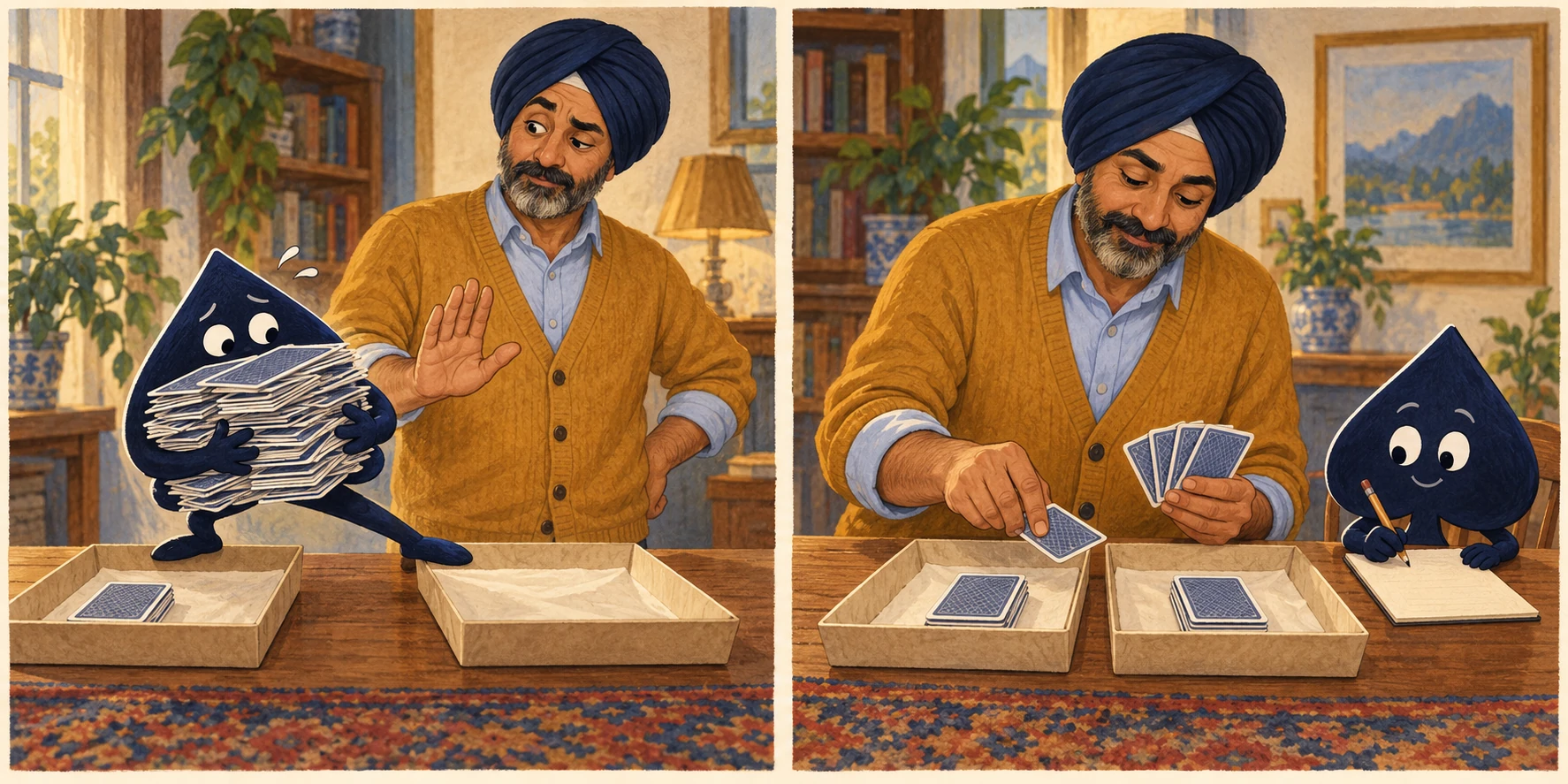
Harjit has set out two trays, and the HPD spade is already trying to put every card in both. Keep your high and low notes separate as you work. This lesson uses imaginary chips and a paper-deck approach, so you can finish it without opening a poker account.

Start with the part you need
New to split-pot poker? Read the game profile and the low-hand check first. If you already play four-card Omaha Hi-Lo, start with what the fifth card changes, then try the six exact-card exercises. Each answer opens separately. Write your own result before revealing it.
The game profile used here
Here, Big O means five-card Omaha Hi-Lo eight-or-better. We use the pot-limit version described in PokerStars’ five-card Hi-Lo rules, with the Big O name also used in SwC’s rules. Both rule pages allow other betting structures. A table labeled only “Big O” still needs a limit, pot-limit or no-limit specification.
- One ordinary 52-card deck, no wild cards, five private cards per player and one five-card community board
- Exactly two private cards and exactly three board cards for each high or low hand
- Traditional high-hand rankings; ace-to-five low with five different ranks, all eight or lower
- One high half and one low half when a low qualifies; the entire pot goes to high when none does
- Pot-limit betting for this lesson; all exercise pots have equal eligibility, no side pots, no rake and no odd chip
Ordinary Omaha Hi-Lo gives each player four private cards. PLO5 high-only uses five but has no low half. Check both the card count and the winning-hand rule. Sharing one of those features does not make the formats interchangeable.
Follow the deal before solving the cards
With three or more players, the small blind is clockwise from the button and the big blind is next. Each player receives five private cards. Preflop action starts clockwise from the big blind. The flop brings three board cards, the turn one and the river one, with a betting round after each. Postflop action begins with the first active player clockwise from the button.
For a paper rehearsal, seat Noor on the button, Eli in the small blind, Jo in the big blind and Sam next. Sam acts first preflop. If Eli stays in, Eli acts first on the flop. If Eli folds before the flop and Jo stays in, Jo is first. The button does not pass to somebody new halfway through that hand.
Do not deal a second board because the pot has two halves. High and low are read from the same board. Nor do players exchange unwanted hole cards. Set the five private cards aside as a fixed starting set and add only the scheduled community cards.
For pot-limit arithmetic, suppose 40 chips are already in the pot before Noor bets 20. Eli faces that bet with no chips committed on the street. Include the 20 needed to call when calculating the pot: 40 plus Noor’s 20 plus that hypothetical 20 is 80. Eli may raise by up to 80, putting in 100 total. This is one raise, not a completed call followed by a separate raise. Use the calculation in the pot-limit maximum-raise lesson. A possible high/low split does not halve the pot for this calculation.
Before a real table starts, also check antes, minimum raises, short all-ins, exposed cards and the room’s odd-chip procedure. Those details belong on its rules sheet. The 240-chip exercise pots below divide exactly, so a local odd-chip rule cannot change their answers.
Ten possible pairs, still only two cards used
Label five hole cards A, B, C, D and E. Their possible pairs are AB, AC, AD, AE, BC, BD, BE, CD, CE and DE. There are ten. Cover E and six remain: AB, AC, AD, BC, BD and CD. The fifth card adds four pairs, one with each earlier card.
On a complete five-card board there are ten possible three-card selections. Ten private pairs times ten board triples gives 100 legal constructions to inspect for one player’s high hand. Inspect the same set for low, with its separate qualification test. Several constructions can describe the same ranked hand; 100 is a count of card selections, not 100 different strengths.
This is a useful review method when the cards look busy. Pick a private pair, list the board triples that can work with it, and reject any construction that changes the two-plus-three count. A tempting sixth card does not become a tiebreaker. The comparison ends with the five cards in the legal hand.
The extra card can add a suited pair, a useful low backup or a new straight combination. It also sits in every opponent’s five-card hand. The combination count alone says nothing about whether a particular starting hand should call or raise. The examples teach what is legal and who wins their stated showdown.
Check qualification before comparing low hands
For a low, write the selected five ranks in descending order and treat the ace as one. Reject a pair or any rank above eight. Compare the highest rank first, then continue to the first difference. A straight or flush does not spoil an ace-to-five low. A qualifying hand can compete for high as well.
Try two rank strings on paper: 7-6-4-2-A and 7-6-4-3-2. The first three positions tie. The next comparison is two against three, so 7-6-4-2-A wins. Do not add the ranks together. Do not jump straight to the ace at the end. Reading left to right shows exactly where the result is decided.
Now compare 8-4-3-2-A with 7-6-5-4-3. The seven-low wins at the first card. Having the smaller ranks at the bottom cannot rescue an eight at the top. This is why “I have an ace and a deuce” is an incomplete showdown description.
A quick board test saves work. You need three distinct board ranks of eight or lower for any low to be possible. A board containing only 4, 8, K, Q and J fails before you inspect a player’s cards. A board containing 2, 2, 8, K and Q also fails: two copies of the deuce supply only one low rank.
Passing that board test creates a possibility, not an automatic low half. A player must still supply two suitable hole-card ranks. You cannot play a wheel lying entirely on the board, and a duplicate rank from your hand may force a different selection. Name all five chosen cards before declaring that a low exists.
Award high and low separately
Use a simple ledger. First name every high winner. Then name every qualifying low winner. With both halves present, divide half the pot among the high winners and half among the low winners. Add each player’s two awards. A player who wins both halves alone scoops; a player who ties a half may receive much less.
| Result in a 240-chip pot | High award | Low award | Total |
|---|---|---|---|
| A wins high and low alone | A 120 | A 120 | A 240 |
| A wins high; A and B tie low | A 120 | A 60; B 60 | A 180; B 60 |
| A wins high; B wins low | A 120 | B 120 | A 120; B 120 |
| A wins high; nobody qualifies for low | A 240 | No low portion | A 240 |
If players are eligible for different amounts because someone is all-in, build the pots first. Then solve high and low within each eligible group. The side-pot and uncalled-bet lesson covers that first step. Dividing one big total among everybody can give chips to a player who was never entitled to that side pot.
Six exact-card exercises
Each exercise is a separate hand. A, B and C are seat labels, and each row lists all five of that player’s hole cards. Suits identify physical cards; they do not break a tie between equal-ranked hands. Each pot contains 240 imaginary chips. All listed players have reached showdown and are eligible for the entire pot.
For each case, write the best high hand, the best qualifying low or “none”, and the amount each player receives. Use the specific private pair and board triple in your answer. A correct winner with an illegal construction needs another look.

1. Three low hole cards cannot repair this board
| Cards | Complete set |
|---|---|
| Board | 4♠ 8♦ K♥ Q♣ J♦ |
| Player A | A♠ 2♥ 3♣ K♦ K♠ |
| Player B | 10♠ 9♥ Q♦ Q♥ 7♣ |
Can A use A♠ 2♥ 3♣ with 4♠ 8♦ for low? Who receives the pot?
Show the construction and chip awards
B receives all 240 chips. B uses 10♠ 9♥ with K♥ Q♣ J♦ for a king-high straight. A’s best high is three kings, using K♦ K♠ with K♥ Q♣ J♦. The straight wins.
No low is possible. The board supplies only two distinct low ranks, four and eight. A’s proposed A♠ 2♥ 3♣ 4♠ 8♦ uses three private cards and only two board cards. Its attractive rank string cannot make that construction legal.
Notice that the error is settled before low-hand strength matters. Writing 8-4-3-2-A beside the cards does not cure the source count. Put the two private cards in one column and the three board cards in another, then check both columns.
2. Use one pair for high and another for low
| Cards | Complete set |
|---|---|
| Board | 2♣ 3♦ 4♥ K♠ K♦ |
| Player A | A♠ 5♠ K♣ K♥ 9♣ |
| Player B | A♣ 6♣ Q♥ Q♠ J♣ |
Find A’s high and low. Must the same two private cards be used for both?
Show the construction and chip awards
A scoops all 240 chips. For high, K♣ K♥ plus K♠ K♦ 4♥ make four kings with a four kicker. For low, A♠ 5♠ plus 2♣ 3♦ 4♥ make 5-4-3-2-A, the wheel. The two selections use different private pairs and different board triples.
B’s best high is kings and queens with a four kicker, using Q♥ Q♠ with K♠ K♦ 4♥. B’s low is 6-4-3-2-A, using A♣ 6♣ with 2♣ 3♦ 4♥. A wins both comparisons.
Do not discard A’s low pair because you already used the kings for high. The two hands are evaluated independently. Nor must A use the same three board cards twice. The king-heavy board triple belongs in the high record; the three small board cards belong in the low record.
3. The nut low still earns only a quarter
| Cards | Complete set |
|---|---|
| Board | 3♠ 4♦ 8♣ K♥ K♦ |
| Player A | A♠ 2♥ Q♣ J♣ 9♦ |
| Player B | A♣ 2♦ K♣ K♠ 10♣ |
A says, “I have the nut low, so I get half.” Check the exact share.
Show the construction and chip awards
A gets 60 chips and B gets 180. B uses K♣ K♠ with K♥ K♦ 8♣ for four kings with an eight kicker. A has only a pair of kings for high; one best construction is A♠ Q♣ with K♥ K♦ 8♣.
Both players make 8-4-3-2-A for low. A uses A♠ 2♥ and B uses A♣ 2♦, each with 3♠ 4♦ 8♣. Those are equal low hands. The 120-chip high half goes to B, while the 120-chip low half is divided into 60 each.
A has tied the best possible low on this board, yet receives a quarter of the whole pot. B’s total is 120 plus 60. This is quartering. The label “nut low” describes hand strength; it does not say how many other players share that strength.
The total check is 60 plus 180 equals 240. These are pot awards, not profit figures. If A had contributed 100 chips earlier, receiving 60 would leave a net loss of 40 for the hand.
4. The fifth card supplies a new river combination
| Cards | Complete set |
|---|---|
| Board | 2♣ 3♦ 8♥ K♠ A♦ |
| Player A | A♠ 4♣ Q♥ J♥ 5♣ |
| Player B | A♥ 4♦ Q♠ J♣ 10♦ |
The first four board cards are the turn. What changes when A♦ arrives on the river, and what job does A’s fifth card do?
Show the construction and chip awards
On the turn, both players have 8-4-3-2-A. A uses A♠ 4♣ and B uses A♥ 4♦ with 2♣ 3♦ 8♥. The river A♦ leaves that old construction available, but opens a stronger one for A.
A now uses 4♣ 5♣ with A♦ 2♣ 3♦ for a wheel. It wins both low and high here. B’s best low remains 8-4-3-2-A. B’s best high is a pair of aces with king, queen and eight kickers, using A♥ Q♠ with A♦ K♠ 8♥. A therefore takes 240.
Cover A’s 5♣ with a scrap of paper. The four visible hole cards A♠ 4♣ Q♥ J♥ cannot make that wheel. Reveal the five and the private pair 4♣ 5♣ becomes available. This is a direct example of the fifth card changing the answer without changing the two-card rule.
The old eight-low did not disappear or acquire a pair; its exact five-card selection still works. Its status changed relative to the new best low. At the turn A-4 made the nut low on this board. After the river ace, 4-5 makes a wheel. Re-read the board rather than assuming a turn label lasts until showdown.
5. An ace-high flush can lose the low half
| Cards | Complete set |
|---|---|
| Board | 2♥ 4♥ 6♥ K♠ Q♦ |
| Player A | A♥ 8♥ 9♣ 9♦ J♣ |
| Player B | 3♣ 7♦ K♣ K♦ 10♣ |
A has an ace and a heart flush. Is that enough to win both halves?
Show the construction and chip awards
The pot splits 120 each. A wins high with the ace-high heart flush A♥ 8♥ 6♥ 4♥ 2♥, using two hearts from the hand and three from the board. B’s best high is three kings with queen and six kickers, using K♣ K♦ with K♠ Q♦ 6♥.
B wins low with 7-6-4-3-2, using 3♣ 7♦ with 2♥ 4♥ 6♥. A’s best low is 8-6-4-2-A, using A♥ 8♥ with the same board triple. Compare the highest cards first: seven beats eight.
The flush is not a penalty in A’s low evaluation. A loses low because the best legal low starts with an eight. Saying “flushes count against low” would get the reason wrong even if you happened to name B as the low winner.
Cover the suits and compare the low rank strings again. Then uncover them for the high comparison. The same physical cards answer two separate ranking questions.
6. Split each half among three equal hands
| Cards | Complete set |
|---|---|
| Board | 3♣ 4♦ 5♥ K♠ Q♦ |
| Player A | A♠ 2♥ K♣ K♥ 9♣ |
| Player B | A♣ 2♦ Q♣ Q♥ 8♠ |
| Player C | A♥ 2♠ J♣ J♥ 7♦ |
Do A’s kings or B’s queens break a tie? Divide both halves among the three players.
Show the construction and chip awards
Each player receives 80 chips. All three make the same five-high straight for high and the same wheel for low: their own ace-deuce pair with 3♣ 4♦ 5♥. The high half is 120 divided by three, or 40 each. The low half is another 40 each.
A can also make three kings, and B can make three queens, but neither beats a straight. Those private pairs do not become extra kickers attached to the wheel. C’s unused jack pair is equally irrelevant once the best five-card hand has been chosen.
The suits of the three ace-deuce pairs do not rank the tied wheels. There is also no sixth card to compare. Record each player’s 40-chip high share and 40-chip low share before adding them. Three totals of 80 return all 240 chips to the players.
This case is a useful check against a tempting shortcut: three players showing qualifying lows does not mean the pot has three low halves. There is one low half, split three ways, and one high half, also split three ways.
Keep a record you can check tomorrow
The spade’s next job is to copy one exercise and change exactly one card. Before comparing the new hands, check that the replacement is not already in that deal. A duplicated physical card can create a convincing answer to a hand that could never be dealt.
For a useful follow-up to exercise 5, change A’s 8♥ to 7♥. A then has a seven-low instead of an eight-low. Compare 7-6-4-2-A with B’s 7-6-4-3-2. The first difference is the fourth rank, so A now wins low as well as the heart flush for high and takes all 240. No other card needs to change. Check the new construction yourself before accepting the result.
Use this checklist while reviewing your own written answer. The boxes are ordinary page controls for this reading session. They do not calculate a score, submit a hand or save a record.
When you miss an answer, record the specific mistake: an illegal card count, a missed high combination, a low comparison or a split calculation. That gives the next practice session a clear job. Use the four-card Omaha Hi-Lo lesson to revisit the low rules, or the PLO5 construction lesson to concentrate on high hands.
There is no need to wager to practice any of these skills. If you choose to play, decide your time and spending limits beforehand; the limits and breaks checklist can help you make that plan. More study topics are in Info & tools.