2-7 Single Draw rules: read the low, finish the draw
The little gap between five and seven matters. A mixed-suit 7-5-4-3-2 is the best hand in 2-7 Single Draw. Replace that seven with a six and you have a straight, which is a much worse lowball hand. An ace does not solve the problem either. Here, every ace is high.
Leila and the HPD spade are working at a practice table with an ordinary deck and chips that have no cash value. Their lesson has one exchange, a complete betting record and six card problems. Keep the exact cards in view. A familiar-looking hand can mean something quite different when you change poker games.

Start with the rule you are most likely to forget
Coming from Five-Card Draw high? Go to the low-hand ranking first. If you know Razz, pause at the ace and straight check. Those two games both reward low hands, but their rankings do not transfer unchanged.
For a first practice deal, follow the single-exchange sequence and the full chip example. If you want to test yourself, jump to the six exercises. Each answer opens separately, so you can explain your choice before seeing the result.
What counts as a good 2-7 hand?
You finish with five private cards. The strongest type of hand has five different ranks, no straight and no flush. Within that type, smaller ranks are better. All five cards matter, and an ace is always the largest rank. There are no community cards and no unused sixth card to borrow as a kicker.
The best possible hand is 7-5-4-3-2 with at least two suits represented. It does not need four different suits. Two clubs and three diamonds would be fine. Five clubs would make a flush and change its category, even though the printed ranks look like the same excellent low.
The name 2-7 does not impose a seven-high qualifying limit. An eight, nine, king or even a pair can win if every remaining opponent has a worse hand. This is a low-only game. You are not trying to qualify for half of a high-low pot, and a player with a pair does not automatically have a dead hand.
| Better to worse | Compare within the same category |
|---|---|
| No pair, no straight, no flush | Read ranks from highest to lowest; lower at the first difference wins |
| One pair | Lower pair first; then remaining ranks from highest downward |
| Two pair | Lower high pair first, then lower second pair, then lower kicker |
| Three of a kind | Lower trip rank first; then remaining ranks downward |
| Straight | Lower top card wins; an ace cannot be the bottom card |
| Flush | Read all five ranks from highest downward |
| Full house | Lower trip rank first; then lower pair |
| Four of a kind | Lower four-card rank first; then lower kicker |
| Straight flush | Lower top card wins, within this weakest category |
Check the category before admiring the small cards. A pair of queens beats a six-high straight in 2-7. That can feel wrong if your first game rewarded high hands, so say the category aloud before comparing numbers. The same habit catches a low-looking flush.
The ace and straight check
A-5-4-3-2 with mixed suits is an ace-high hand in this game. It is not a five-high straight, because the ace cannot play low. It loses to an unpaired king-high hand that is neither a straight nor a flush. It still beats a pair, because category comes first.
By contrast, 6-5-4-3-2 really is a straight. So is 7-6-5-4-3. Both are worse than any one-pair hand in 2-7. At the other end, A-K-Q-J-10 is an ace-high straight. There is no wraparound sequence joining a king, ace and two.
If A-5-4-3-2 is all one suit, the hand is an ace-high flush. The ace rule removes the five-high straight; it does not remove the flush. When reviewing a hand record, keep the suits until you have completed this check. Rank-only notes can hide the very feature that decides the result.
Read the largest card first
Once both hands are in the no-pair, no-straight, no-flush category, put each set of ranks in descending order. Compare the highest cards. If those match, compare the next ones. Continue only until you find a difference. The lower rank at that first difference wins; cards farther along cannot reverse it.
For example, 8-7-5-4-2 beats 8-7-6-3-2. The eight and seven match. Five beats six at the next comparison, so the three in the second hand never gets a vote. Adding up the ranks would answer a different question and can produce the wrong winner.
An informal name such as “an eight-seven” may be useful during conversation, but it is incomplete when two hands begin with the same two ranks. Keep the full five-card sequence in a study note. If all five comparison ranks match and the categories match, the hands tie. Spades do not beat hearts to settle a showdown.
One exchange, with betting on each side
This lesson uses a button-and-blinds profile, five cards per player and an ordinary 52-card deck without jokers. A player may discard zero through five cards and receives the same number of replacements. Zero is called standing pat. There is one betting round before the draw and one afterward.
- Deal five private cards to each player
- Complete the first betting round, starting with the first active player left of the big blind
- Take the single draw in order, starting with the first active player left of the button
- Complete the final betting round, again starting with the first active player left of the button
- Compare the remaining hands if more than one player is still in
Action moves clockwise. Players who have folded no longer take part. If everyone but one player folds before the draw, the hand ends there. There is no need to deal replacements or reveal a low merely to complete the list above.
Standing pat uses the one draw opportunity without exchanging a card. It does not reserve an exchange for later. Taking one card, seeing that it pairs you and asking to trade again is not part of Single Draw. Triple Draw gives players three draw opportunities and four betting rounds; that extra sequence belongs to a different game.
Keep your own retained cards separate from the cards you are giving up. If two leave your hand, two arrive. You should have five again before continuing. The discarded card is out of your final hand, however helpful its rank might have been. Record the original cards, discards and replacements separately when you study a hand afterward.
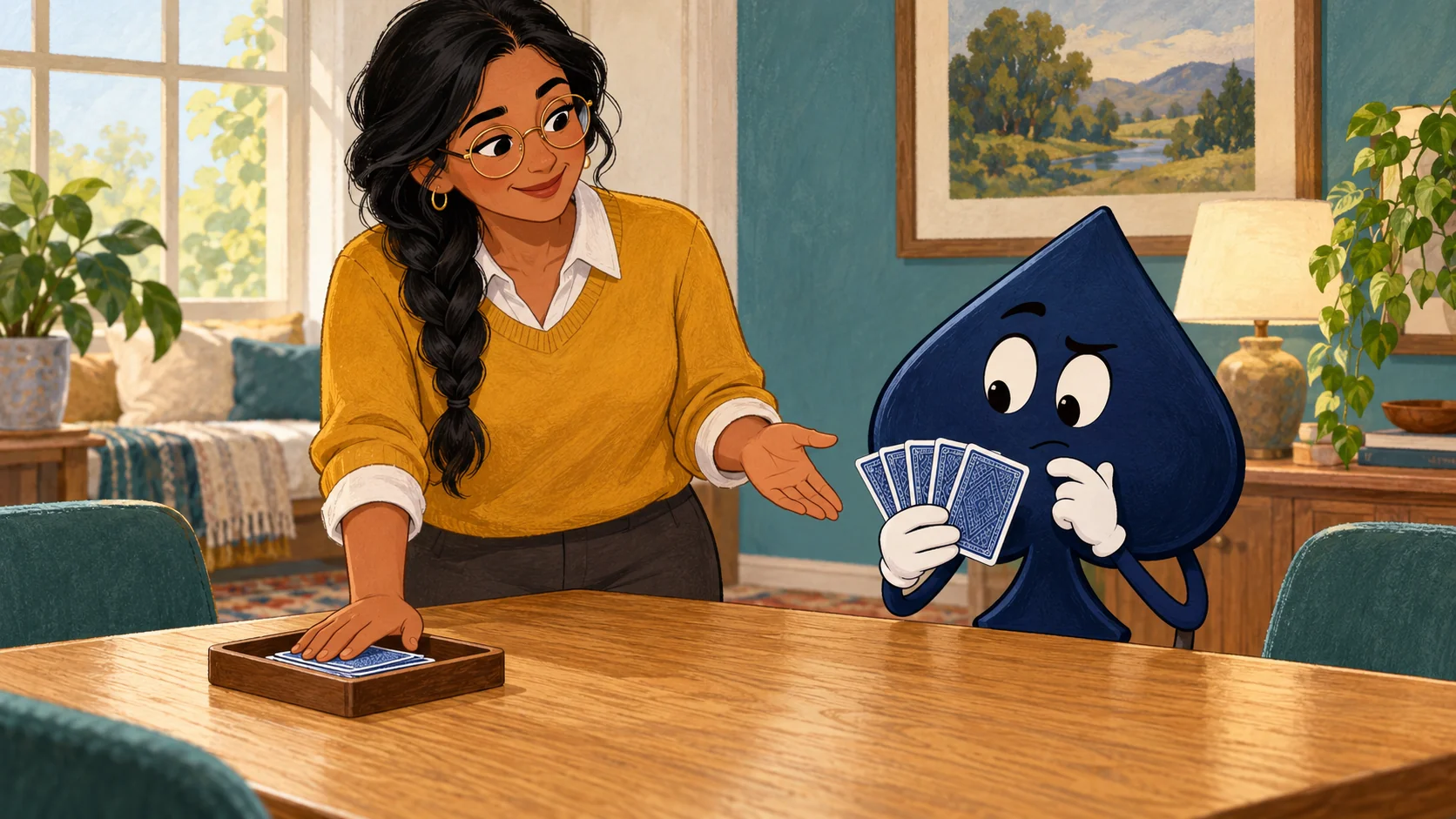
The draw count is public information, but the private cards remain unknown until shown. “Drew one” describes an action. It does not prove a player was drawing to a seven, and “stood pat” does not prove a strong made low. Keep those observations separate from guesses about what an opponent held.
Agree on the betting and dealing rules before starting
No-limit is a common Single Draw format. That still leaves details to check, including blinds, antes, opening requirements and the handling of short all-ins. Some structures require an unopened pot to be entered with a raise. Read the actual table or tournament rules rather than assuming every draw game uses the same opening procedure.
The paper example below has no ante and begins with a raise. Its bet sizes are stated in advance, with enough chips behind to avoid all-in complications. A raise “to 12” means a total of 12 for that betting round. A player who already posted 4 adds 8 to match it.
After the draw, a player facing no bet can check or make a legal bet. Facing a bet, a player may fold, call or raise under the chosen structure. Checking does not remove you from the hand; a later bet can bring action back to you. Once everybody has spoken once, check whether the round has actually closed.
Ask the dealer or host to resolve an exposed card, a wrong card count or an exhausted deck under the applicable rules. Do not repair those problems by inventing a second draw or returning your own discard to your hand. The exact-card examples here have enough unused cards and require no reshuffle.
A complete hand, from the blinds to the final stacks
Four people each start with 120 practice chips. Clockwise around the table are Leila on the button, Ivo in the small blind, Jo in the big blind and Ren. The blinds are 2 and 4. There are no antes, fees, all-ins or side pots. Treat every action as a prescribed rehearsal, not a recommendation about how to play these holdings.
Ren acts first and raises to 12. Leila calls 12. Ivo folds after posting 2. Jo has already posted 4 and adds 8 to call. Three live players have contributed 12 each, and Ivo left 2 in the middle. The pot is 38.
| Player | Original five | Discard | Replacement | Final five |
|---|---|---|---|---|
| Jo | 9♠ 7♦ 4♣ 3♥ K♠ | K♠ | 2♦ | 9♠ 7♦ 4♣ 3♥ 2♦ |
| Ren | 8♥ 6♣ 5♦ 2♠ Q♥ | Q♥ | 3♣ | 8♥ 6♣ 5♦ 3♣ 2♠ |
| Leila | 7♥ 6♦ 4♠ 3♦ 2♣ | None | None | 7♥ 6♦ 4♠ 3♦ 2♣ |
Jo and Ren each exchange one card. Leila stands pat. Jo has a nine-high hand, Ren has an eight-high hand and Leila has a seven-high hand. None is paired, a straight or a flush. The initial kings and queens shown in the discard column do not remain available at showdown.
Jo is the first active player left of the button and checks. Ren bets 16. Leila raises to 40, an increase of 24 over the bet she faces. Jo folds. Ren adds 24 to call, reaching the same post-draw total of 40. Both the opening raise and the later raise satisfy the usual no-limit minimum increase in this example.
| Player | Before draw | After draw | Total contributed |
|---|---|---|---|
| Ivo | 2 | 0 | 2 |
| Jo | 12 | 0 | 12 |
| Ren | 12 | 40 | 52 |
| Leila | 12 | 40 | 52 |
| Total | 38 | 80 | 118 |
Leila and Ren reach showdown. Leila has 7-6-4-3-2 and Ren has 8-6-5-3-2. Their highest cards settle it immediately: seven is lower than eight. Leila wins the 118-chip pot. Jo has folded, so Jo has no claim to it.
| Player | Starting stack | Subtract contribution | Add pot received | Ending stack |
|---|---|---|---|---|
| Ivo | 120 | 2 | 0 | 118 |
| Jo | 120 | 12 | 0 | 108 |
| Ren | 120 | 52 | 0 | 68 |
| Leila | 120 | 52 | 118 | 186 |
| Total | 480 | 118 | 118 | 480 |
Leila receives 118 chips but gains 66 compared with the starting stack. The other 52 were Leila’s own contribution coming back. Keep pot received and net stack change in separate columns if you want a hand record that adds up.
Now change just Ren’s last decision. If Ren folds to Leila’s raise, the unmatched 24 is returned to Leila. The contested pot is 70: the earlier 38, Ren’s 16 and the matched 16 from Leila. Leila takes it without a showdown. This branch ends with stacks of Ivo 118, Jo 108, Ren 92 and Leila 162, again totaling 480.
Six exercises: choose the reason before opening the answer
Each exercise is a separate deal. A, K, Q and J mean ace, king, queen and jack. The symbols ♠, ♥, ♦ and ♣ mean spades, hearts, diamonds and clubs. Every displayed hand has five cards. Only the last exercise supplies a pot to split.
Say the category first, then identify the first decisive rank if a rank comparison is needed. Use Tab to reach an answer and Enter or Space to open or close it. These native answer panels work without JavaScript.
1. A pat hand meets another seven
A stands pat with the cards below. B finishes the draw and reaches showdown. How many replacement cards does A receive, and which seven-high hand wins?
| Player | Final cards |
|---|---|
| A | 7♠ 5♦ 4♣ 3♥ 2♠ |
| B | 7♥ 6♣ 4♦ 3♣ 2♥ |
Check exercise 1: the pat seven
A receives zero replacements and wins with 7-5-4-3-2. Both hands have the same highest card, seven. The next comparison is five against six, and five is lower. A holds the best possible 2-7 rank pattern without a flush.
Standing pat preserved A’s cards; it did not improve them or prove their strength to B. You can identify the hand here because the exercise shows it. A draw count on its own would not give you that information.
2. Both players say “eight-seven”
The first two ranks match. Which card decides this comparison?
| Player | Final cards |
|---|---|
| A | 8♠ 7♦ 5♣ 4♥ 2♠ |
| B | 8♥ 7♣ 6♦ 3♠ 2♣ |
Check exercise 2: the third comparison
A wins. Read 8-7-5-4-2 against 8-7-6-3-2. The first difference is five against six. B’s three is lower than A’s four, but that later difference cannot overturn the earlier one.
Write all five ranks in your answer. “Eight-seven wins” would leave the deciding information out of this particular hand record.
3. The familiar wheel
A has an ace, deuce, three, four and five with mixed suits. B has a king-high hand. Name A’s category under 2-7 rules, then choose the winner.
| Player | Final cards |
|---|---|
| A | A♠ 5♦ 4♣ 3♥ 2♠ |
| B | K♥ Q♦ 9♣ 6♥ 3♠ |
Check exercise 3: ace-high really means ace-high
B wins. A has an ace-high unpaired hand, not a five-high straight. B’s king is lower than A’s ace, and neither hand is a flush or a straight.
Do not carry the wheel ranking across from an ace-to-five game. Also avoid calling A’s hand dead. It is a live ace-high hand and could beat a pair at showdown.
4. Small cards, wrong categories
Three players survive to showdown. Rank all three hands from best to worst. Does anyone have to be disqualified for failing to make a clean low?
| Player | Final cards |
|---|---|
| A | 6♠ 5♦ 4♣ 3♥ 2♠ |
| B | 8♥ 7♥ 5♥ 4♥ 2♥ |
| C | Q♠ Q♦ 9♣ 6♦ 3♠ |
Check exercise 4: the queens win
The order is C, A, B. C has one pair, A has a six-high straight and B has an eight-high flush. One pair is better than a straight in 2-7, and a straight is better than a flush. C wins with the pair of queens.
All three hands remain ranked hands. The straight and flush count against their holders; they do not create a special disqualification. There is no requirement that the winner produce seven-high or better.
5. One replacement creates a pair
A discards the queen and receives the six of clubs. B’s completed hand is shown below. Can A request another draw, and who wins if these hands reach showdown?
| Record | Cards |
|---|---|
| A before draw | 8♠ 6♦ 4♣ 3♥ Q♦ |
| A discards | Q♦ |
| A receives | 6♣ |
| A final hand | 8♠ 6♦ 6♣ 4♣ 3♥ |
| B final hand | J♥ 9♠ 7♦ 5♣ 2♥ |
Check exercise 5: the exchange is finished
A has a pair of sixes. B has an unpaired jack-high hand with no straight or flush, so B wins. The single exchange is finished; A cannot trade another card after seeing this replacement.
Drawing a smaller card did not guarantee a better final hand. The six paired an existing rank. This example shows the result of the stated exchange, without claiming that drawing or standing pat was the best decision beforehand.
6. Different suits, equal hands
A and B are the only players eligible for a 42-chip pot. There is no fee or odd chip. Both reach showdown. Does one suit win, or is there a split?
| Player | Final cards |
|---|---|
| A | 9♠ 7♦ 5♣ 4♥ 2♠ |
| B | 9♥ 7♣ 5♦ 4♠ 2♥ |
Check exercise 6: divide the pot
The hands tie. Each is 9-7-5-4-2, neither is a straight or flush, and every comparison rank matches. Suits do not break the tie. Each player receives 21 of the 42 chips.
Those 21 chips are the amount received from the pot. The exercise does not give the players’ earlier contributions or starting stacks, so it does not establish either player’s net gain.
Review one hand without guessing

Use this checklist after a practice hand. The boxes are simple on-page controls, with no submission or account required. They are a temporary aid for this visit; copy any notes you want to keep into your own notebook. With a keyboard, Tab moves to each box and Space toggles it.
For your next paper deal, change one card rather than the whole exercise. In exercise 2, ask what would happen if the two highest ranks still matched but the third ranks swapped places. In exercise 4, identify the category that made each hand lose before trying a different draw. Explain the new comparison in a sentence before you check it.
These checks can make a hand record accurate. They do not establish that a betting line was optimal or that a draw will make money. Reviewing a decision needs the information available at the time, including stacks, action, opponent tendencies and the rules of the actual game.
You can complete the lesson entirely with paper cards and counters. If you choose to play for money, keep it within a limit you can afford to lose and stop at the break or budget you set beforehand. HPD’s guide to limits and breaks can help you make that plan before sitting down.