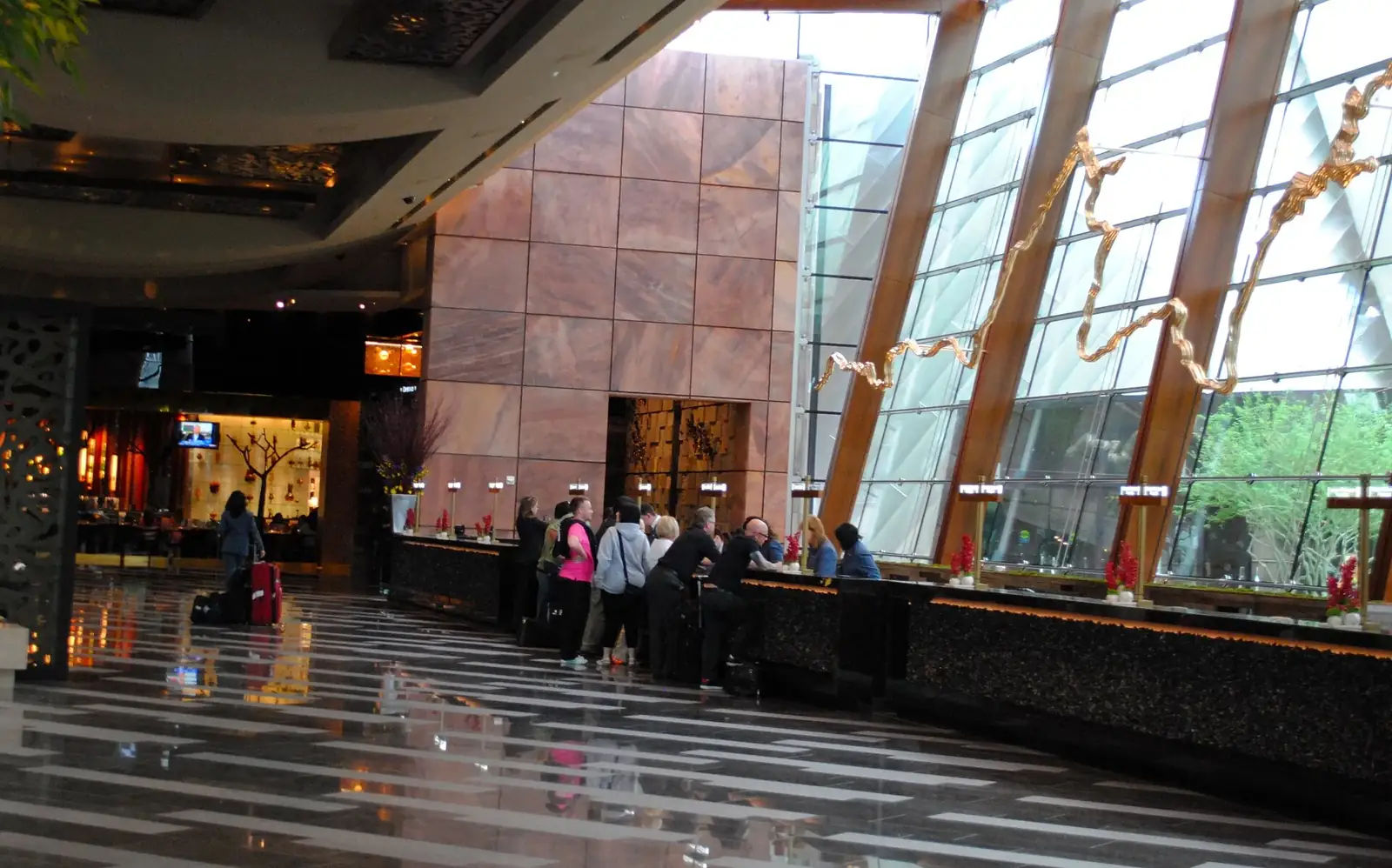
The lobby of ARIA in Las Vegas. The PGT Sprint is played at the PokerGO Studio inside ARIA. Photo: Deidre Woollard / Wikimedia Commons, CC BY 2.0.
Most poker festivals give you time to settle in. Day 1, Day 2, a rest day, a final table, a hotel buffet in between. The PGT Sprint gives you one day. Seven tournaments run on seven days at the PokerGO Studio in Las Vegas, every one of them starts and finishes on the same date, and nobody bags chips for tomorrow.
Two events in, the sprint already has two stories. On Tuesday Chino Rheem won Event #1 after he picked off a bluff with pocket tens and then called an all-in with seven-deuce without looking at his cards. On Wednesday Brock Wilson came from well behind against Martin Zamani, a player who had never lost a heads-up match in a live tournament, and took his fifth PokerGO Tour title of 2026.
Series
PGT Sprint 2026
Dates
October 27 to November 4
Format
Seven one-day events
Buy-ins
$5,300 and $10,500
Seven tournaments, no Day 2
The PGT Sprint is a short series inside the PokerGO Tour, the season-long points race run by PokerGO. The first four events cost $5,300 each. The last three cost $10,500. Every event is no-limit hold’em, and every one is a single-day tournament, so a player who runs deep on a Tuesday is either a winner or out by the end of the night.
The timing matters as much as the format. The 2026 PGT season ends with the PGT Championship on January 11 and 12, 2027, a $500,000 freeroll for the top 40 eligible players on the leaderboard plus a few Dream Seat winners. For anyone sitting around 40th, a week of one-day events in late autumn is the last good chance to move up.
| Event | Date | Buy-in |
|---|---|---|
| #1 No-Limit Hold’em | October 27 | $5,300 |
| #2 No-Limit Hold’em | October 28 | $5,300 |
| #3 No-Limit Hold’em | October 29 | $5,300 |
| #4 No-Limit Hold’em | October 30 | $5,300 |
| #5 No-Limit Hold’em | November 2 | $10,500 |
| #6 No-Limit Hold’em | November 3 | $10,500 |
| #7 No-Limit Hold’em | November 4 | $10,500 |
The dates come from the PGT schedule. The Sprint runs at the same PokerGO Studio inside ARIA that hosted the Poker Masters finale last week, so many of the faces are the same ones that played for the Purple Jacket.
Event #1: 92 players, 14 paid, one familiar winner
Event #1 drew 92 entries and built a $460,000 prize pool, with the top 14 paid. Jim Collopy went out in 15th on the money bubble. After him the field lost Michael Rossitto, Justin Vaysman, 2015 world champion Joe McKeehen, David Coleman, Darren Rabinowitz, Brock Wilson and Nick Seward, which left seven players at the final table.
Neil Warren started that table with the chip lead, and Rheem was third. John Riordan went first, when his ace-queen suited lost a flip to Andrew Lichtenberger’s pocket tens. Then Michael Berk did something twice in a row that most players do not manage once. He went in behind and won both times. His queen-jack suited beat Jesse Lonis’ ace-ten for sixth place, and his ace-three beat Warren’s ace-queen for fifth.
A third escape was too much to ask. Berk, short on chips, put them in with jack-five of diamonds and ran into Rheem’s king-jack of hearts. Patrick Leonard went out in third when his ace-queen met Lichtenberger’s pocket kings. Lichtenberger began heads-up with more chips than Rheem.
Pocket tens, then seven-deuce in the dark
The heads-up match did not last long. The key hand finished on a queen-eight-six-eight-jack board. Lichtenberger bet as if he had it, Rheem decided he did not, and Rheem called with pocket tens. Lichtenberger had nine-five. The bluff was picked off, and Lichtenberger was left with a very short stack.
On the next hand Lichtenberger moved all in with six-five. Rheem called dark with seven-deuce, the worst starting hand in hold’em. The board came ace-nine-eight-four-queen. Nobody made a pair, Rheem’s seven was the higher card, and the tournament was over.
So here is a question for you. Would you call off a short stack with seven-deuce without looking? With the opponent that short, the price was good and almost any two cards had a fair chance. It still takes a certain kind of player to do it with cameras on. If seven-deuce is your favourite hand anyway, our page on the seven-deuce bounty explains the home-game rule that pays you for winning with it.
| Place | Player | Prize |
|---|---|---|
| 1 | Chino Rheem | $119,600 |
| 2 | Andrew Lichtenberger | $75,900 |
| 3 | Patrick Leonard | $55,200 |
| 4 | Michael Berk | $41,400 |
| 5 | Neil Warren | $32,200 |
| 6 | Jesse Lonis | $23,000 |
| 7 | John Riordan | $18,400 |

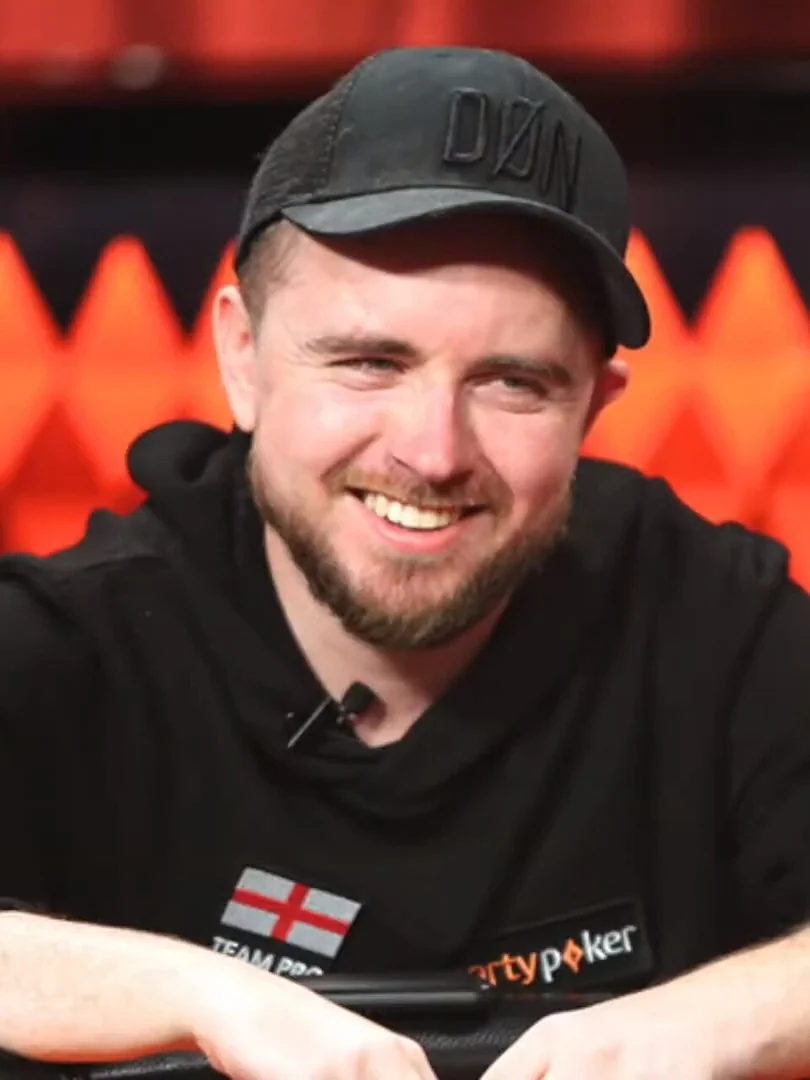
Who is Chino Rheem?
David “Chino” Rheem is a Los Angeles player born in 1980, and his name has been on big final tables for almost two decades. He finished seventh in the 2008 WSOP Main Event for $1,772,650, the year Peter Eastgate won it, and went out when his ace-king lost to Eastgate’s ace-queen. A few weeks later he won the WPT Doyle Brunson Five Diamond World Poker Classic for $1,538,730.
Two more World Poker Tour titles followed: the 2013 WPT Championship, where he beat Erick Lindgren heads-up for $1,150,297, and the Seminole Hard Rock Poker Finale in 2016. In 2019 he won the $10,300 PokerStars Caribbean Adventure Main Event for $1,567,100. Card Player puts his career tournament earnings above $20.3 million after this win.
On the PokerGO Tour he is a regular winner. Event #1 was his 10th PGT title and his second this season. The first came in February, in a $5,300 H.O.R.S.E. event at the PGT Mixed Games, for $112,100. He has four PGT series titles already, and Card Player notes that this Sprint gives him a shot at a record fifth.
| Year | Result | Prize |
|---|---|---|
| 2008 | 7th, WSOP Main Event | $1,772,650 |
| 2008 | Winner, WPT Five Diamond World Poker Classic | $1,538,730 |
| 2013 | Winner, WPT Championship | $1,150,297 |
| 2019 | Winner, PCA Main Event | $1,567,100 |
| 2026 | Winner, PGT Sprint Event #1 | $119,600 |
The 179 points from Event #1 moved Rheem to 19th on the season leaderboard. With two wins, 23 cashes and 1,220 points this season, PokerGO describes him as firmly in a qualifying position for the PGT Championship.
Lichtenberger, second and then sixth
Andrew Lichtenberger, known online as LuckyChewy, has plenty of big days of his own. He won the WPT Alpha8 in Las Vegas in December 2014 for $2,104,245 after beating Tom Marchese heads-up, and he won a WSOP bracelet in 2016. In the Sprint he made both final tables. Second in Event #1 was worth $75,900, and sixth in Event #2 added $19,750.
Those two finishes brought him 144 points and moved him from 31st, where he started the series, to 20th with 1,217. That puts him three points behind Rheem.
Event #2: Martin Zamani and the power of ten-nine
Wednesday’s Event #2 drew 79 entries for a $395,000 prize pool, with 12 places paid. Landon Tice went out on the bubble, and Josh Arieh, Jeremy Becker, Frank Brannan, Matthew Wantman and Jeremy Ausmus followed him before the final seven sat down. Jamie Dwan had the chip lead, and Brock Wilson was among the short stacks.
Wilson doubled through Lichtenberger early. Jesse Lonis knocked out Adam Owen in seventh, and Wilson then sent Lichtenberger out in sixth. After that the table belonged to Martin Zamani, whose aggression produced most of the big swings. With five left he open-shoved from the button for more than 43 big blinds. Dwan reshoved from the small blind with ace-king. Zamani had king-queen, a queen came on the flop, and Zamani held. That double gave him a big chip lead, and Dwan went out in fifth soon after.
The lead did not stay comfortable. Wilson doubled through Zamani with pocket jacks against pocket threes, and Lonis doubled with pocket aces against Zamani’s ace-six. Zamani answered with the same hand twice. His ten-nine trailed Joe McKeehen’s ace-queen on an ace-ten-two flop, a ten on the turn gave Zamani trips, and McKeehen was out in fourth. Ten-nine then beat Lonis’ ace-four, and Lonis went out in third.
Wilson against an unbeaten record
Zamani took a big chip lead into heads-up, along with a record that very few tournament players have. He had never lost a heads-up match in a live tournament. Wilson doubled up twice to erase the gap and then took the lead.
On the final hand Wilson raised with ace-king, Zamani moved all in with ace-three, and Wilson called. The board gave Wilson a pair of kings, and Zamani was drawing dead by the turn. It was his first runner-up finish in a live tournament, which is the kind of first nobody frames.
| Place | Player | Prize |
|---|---|---|
| 1 | Brock Wilson | $110,600 |
| 2 | Martin Zamani | $71,100 |
| 3 | Jesse Lonis | $51,350 |
| 4 | Joe McKeehen | $37,525 |
| 5 | Jamie Dwan | $27,650 |
| 6 | Andrew Lichtenberger | $19,750 |
| 7 | Adam Owen | $15,800 |

Brock Wilson’s year
Wilson’s win was worth $110,600 and 166 points. Before Wednesday he was tied with Sam Soverel and Adrian Mateos on four PGT titles this season. Now he has five on his own. Card Player counts 16 PGT cashes for him in 2026, worth more than $1.6 million, and more than $15.6 million in career earnings.
Most of those titles came in two bursts. Earlier this year he won two PokerGO Cup events and two U.S. Poker Open events, and he was series champion at both. Across the first two Sprint events he collected 187 points and climbed from seventh to second on the season leaderboard. He finished ninth in Event #1 the night before, which also paid.
| Rank | Player | PGT points |
|---|---|---|
| 1 | Sean Winter | 2,223 |
| 2 | Brock Wilson | 1,942 |
| 3 | Eelis Parssinen | 1,843 |
| 4 | Jeremy Ausmus | 1,836 |
| 5 | Alex Foxen | 1,777 |
Sean Winter still leads by 281 points. Winter won the Poker Masters finale last week, so the Player of the Year race now comes down to the last five Sprint events and the Last Chance tournaments in January. Five one-day tournaments is not much time, but Wilson has shown this year that he does not need much.
Joe McKeehen, still at the final tables
Joe McKeehen played both days. He went out in 12th in Event #1 and in fourth in Event #2, for $37,525. He won the 2015 WSOP Main Event for $7,683,346, beating Josh Beckley heads-up, and later added bracelets in the $10,000 Limit Hold’em Championship in 2017 and a WSOP Online High Roller in 2020. Wikipedia puts his live earnings above $21 million as of February 2026, so a fourth place in a $5,300 one-day event is a normal Wednesday for him.
The race for the $500,000 freeroll
Every Sprint result moves the bottom of the top 40, and that line is where the real tension sits. To play the PGT Championship from the leaderboard you need enough points, at least four PGT cashes this season with one in a PGT-owned event, and an opt-in before the final series. If a player in the top 40 does not qualify, the seat rolls to the next eligible player.
| Player | After two Sprint events | Place |
|---|---|---|
| Andrew Lichtenberger | 1,217 points (from 31st) | 20th |
| Martin Zamani | 1,131 points (up eight places) | 28th |
| Michael Berk | 1,114 points after Event #1 | 30th |
| Jesse Lonis | 935 points (from 49th) | 42nd |
| Josh Arieh | 908 points (from 46th) | 44th |
Jesse Lonis is the name to watch. He cashed in both events, added 112 points and is now 13 points behind Benny Glaser in 40th. Josh Arieh is 40 points short of the cutoff. Zamani’s second place gave him a cushion of 183 points over the line. Berk’s fourth place in Event #1 lifted him to 30th.
If you play tournaments yourself, our guide to tournament types explains how single-day events like these differ from the multi-day formats most festivals use.
What comes next
Events #3 and #4 complete the $5,300 part of the series, and the three $10,500 events run from November 2 to 4. After that the PGT moves to the Last Chance events from January 4 to 8, 2027, and then the PGT Championship on January 11 and 12. We will follow the race for the top 40 and the Player of the Year title.
Your turn. Who wins the PGT Player of the Year title, Winter with his 281-point lead or Wilson with five titles and a habit of winning in bunches? And would you have called with seven-deuce?
Sources: PGT: Chino Rheem wins PGT Sprint Event #1, PGT: Brock Wilson wins PGT Sprint Event #2, Card Player: Chino Rheem triumphs in PGT Sprint kickoff event, Card Player: Brock Wilson speeds to his fifth PokerGO Tour victory of 2026, Hochgepokert: PGT Sprint 2026 Event #1, Wikipedia: Chino Rheem, Wikipedia: Andrew Lichtenberger, Wikipedia: Joe McKeehen.