A poker study routine you can keep
You sit down to study a turn decision. Forty minutes later, six tabs are open and you have watched someone explain a completely different game. The video made sense. What will you remember on Thursday?
Give the week one question, a written attempt and a return visit. That is enough structure to begin. This routine helps you leave each block with something you can explain again, including the assumptions that make the answer useful. A notebook is fine. You do not need a new subscription or a perfect daily streak.
Choose a question you can actually answer
“Get better at river play” is a wish for the month. “Calculate the price of a river call without forgetting my own call in the final pot” is a workable question for tonight. Other useful targets include identifying the effective stack, comparing two preflop positions in the same model, or explaining what changed on one turn card.
Pick something that has left you uncertain more than once. Write the question before opening your material, then choose a small input: one explanation, one formation or a few related examples. If the question needs an hour just to define its terms, cut it down.
Keep a separate parking list for interesting distractions. “Look at tournament payouts later” belongs there while you are studying cash-game call prices. Ace will happily hold that thought for you. It does not have to become tonight’s second project.
Quest 1: which question fits a 20-minute block?
Choose between “understand three-bet pots” and “compare how one specified preflop model treats A5 suited when opening from the cutoff versus the button.”
The second question gives you something you can inspect. Keep the game format, stack depth, rake assumptions and opening size fixed; record what the model recommends and any explanation you can support. If those inputs differ, you have not isolated position. Twenty minutes may still leave an unanswered question, which is worth recording.
Give the week three small appointments
Here is a starting schedule for a busy week. Move the days to fit your life. The gaps give you a chance to try the idea again after the first explanation is no longer right in front of you.
- Monday, 30 minutes: choose the question, attempt a couple of examples, inspect one explanation and write a corrected answer
- Thursday, 15 minutes: answer from memory first, then check two changed examples and correct any mistakes
- Sunday, 15 minutes: review the week’s notes, decide what remains uncertain and prepare the next question
This is a suggested 60-minute week, not a minimum commitment or a professional training schedule. If you have one short opening in the week, use it well and return when you can. Do not borrow time from sleep just to complete a study calendar.
Make each appointment easy to start. Leave the question, the next example and the location of your source together. “Continue studying” is a poor instruction to your future self. “Solve the 60-chip pot with a 45-chip bet before reading the answer” gives you a clear first move.
Spend the block on an attempt and a correction
For a 30-minute block, use roughly five minutes to state the question and try it, twelve to inspect the explanation, ten for fresh attempts and three to leave a useful note. Those numbers are guardrails. Stop the explanation early if you already have enough to test.
With 15 minutes, use one example and one changed version. With an hour, take a break and add a second round of attempts; avoid filling the extra time with unrelated videos. End with a question you can revisit even if the study itself felt unfinished.
Put the answer out of sight before trying. Saying “yes, that makes sense” while looking at a worked solution tells you very little about what you can produce alone. A rough written answer gives you something to correct.
Keep a decision record short enough to use
A screenshot can preserve a result, but it rarely explains what you were trying to learn. Add a few lines that let you rebuild the reasoning. Here is a complete record for a deliberately simple river exercise.
- Question: what is the break-even equity for calling 30 chips into a pot that held 40 before the opponent bet?
- My first answer: 30 divided by 70, or about 42.9%
- Assumptions: heads-up, one equal call, no further betting, no rake and chip-value accounting
- Correction: the final pot also includes my 30-chip call, so 30 divided by 100 is 30%
- Next attempt: change the starting pot and bet; write all three pot components before dividing
Keep your first answer. Replacing it with the correct number erases the clue about what went wrong. Here, the problem was the denominator. Watching a longer video about river ranges would not directly fix that arithmetic error.
For a strategic decision, also record the action you chose and why. Include position, effective stack, game format and relevant model inputs. A useful sentence might be: “I chose call because I estimated enough weaker hands in the betting range; that range estimate still needs checking.” An unresolved assumption belongs in the note.
Turn a source into a question you can reuse
When a video answers your question, save its title and timestamp in your own notes. When a model supplies the answer, record its settings. You want to find the original explanation again without searching through everything you watched that week.
Then write a prompt whose answer is hidden. A preflop screenshot becomes more useful when the front of your note names the formation and asks what changes for one hand; the reverse holds the recommendation and its conditions. Do not strip away those conditions to make a shorter flashcard.
A source may give an answer you cannot yet explain. Write that honestly: “The model recommends this action; I do not yet understand which range interaction drives it.” Your next task is to investigate that gap. Guessing a confident story would leave you rehearsing an explanation you have never checked.
Check what stayed the same before comparing answers
Two outputs can disagree because they answer different questions. Before calling something a mistake, compare the stacks, positions, action sequence, available bet sizes and rake or payout assumptions. Identify the changed input instead of treating the difference as a mysterious rule.
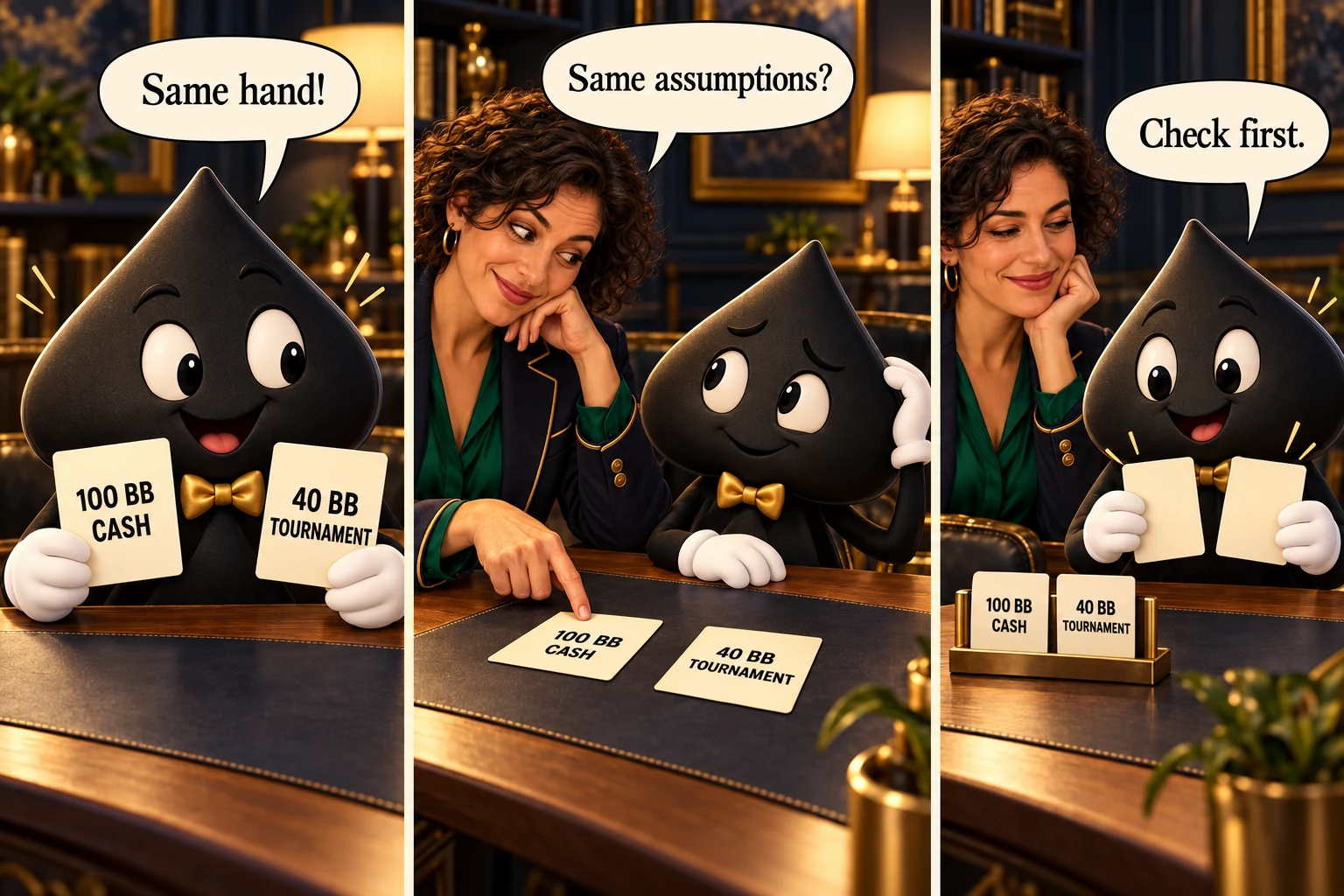
Quest 2: did the lesson prove that position caused the change?
On Monday you inspect a 100-big-blind cash-game model. On Thursday you open a 40-big-blind tournament model and see a different recommendation for the same hole cards. Can you attribute the difference to position?
No. Stack depth and game model have changed, and tournament incentives may also differ. Record the mismatch and find a like-for-like comparison before drawing that conclusion. If you cannot obtain one, leave the explanation unresolved rather than inventing a reason.
Work one small idea all the way through
Try these call-price exercises away from play. The pot contains 40 chips before your opponent bets. You may fold or make one equal call; there is no rake or further betting. The break-even equity is the call cost divided by the final pot, including your call.
Write an answer before opening each explanation. First assemble the pot in chips, then convert the fraction to a percentage. Keep the arithmetic separate from estimating whether a particular hand has enough equity against a range.
Quest 3: a 10-chip bet, then a 20-chip bet
Against 10, the final pot is 40 + 10 + 10 = 60. The threshold is 10 / 60, or about 16.7%. Against 20, the final pot is 40 + 20 + 20 = 80. The threshold is 20 / 80, or 25%.
The starting pot is unchanged, but the call price is different. If you answered 25% for both, write the pot components again before attempting the next pair.
Quest 4: a 30-chip bet, then a 40-chip bet
Against 30, the final pot is 100, so the threshold is 30%. Against 40, the final pot is 120, so the threshold is about 33.3%.
At the threshold, calling breaks even relative to folding under these assumptions. The arithmetic does not tell you an opponent’s range or your hand’s equity against it. Treat those as separate questions.
Save a changed example for Thursday: the pot starts at 60 and the opponent bets 45. Resist checking it now if you want a fresh prompt later.

Thursday’s check: 60 in the pot, facing 45
The final pot is 60 + 45 + 45 = 150. Calling costs 45, so the threshold is 45 / 150 = 30%. The numbers changed, but the bet is still three-quarters of the starting pot, just like betting 30 into 40.
Explain that relationship in your own words. If you remembered 30% but could not rebuild the calculation, keep the question in your next review.
Make the return visit a real attempt
Start Thursday with your notebook closed. State the question, write the answer and list its assumptions. Then open your notes. Mark what you forgot separately from what you understood incorrectly.
Research on memory tasks supports practicing recall rather than relying only on rereading. Applying that idea here is a practical study choice; it does not establish a poker win-rate gain or a single ideal review interval. Use the return visit to find out what you can reconstruct.
Change one feature of the next example. Use a new bet size for arithmetic, another hand in the same formation for range study, or one different turn card for a board comparison. Changing everything at once makes it harder to tell which part you understood.
Review the error, not just the score
On Sunday, read the short records. Did you leave out your call again? Use the wrong effective stack? Copy a recommendation without checking the game model? These are different problems and need different next steps.
A familiar quiz score can be flattering. Nine correct answers on repeated prompts and five on changed examples are not interchangeable results. Keep the prompt type and assumptions beside the score; neither number alone proves that a poker leak is fixed.
You can also connect the topic to a few permitted saved hands. For the separate task of examining a decision without letting the result dictate your verdict, use our hand-history review guide. This weekly routine gives that review a place in the calendar and a question to carry forward.
When the week goes sideways
Missed Thursday? Resume with its first unanswered prompt. A catch-up marathon is optional, and often impractical. Keep the next block small enough that you will actually start it.
If the topic remains muddy, shrink it. Replace “understand the river range” with “write the call price correctly.” If you can explain it and solve changed examples, set it aside for a later check and choose the next useful question. There is no universal number of correct answers that makes a topic finished.
Before using software, check your room’s current rules. Some advanced tools are prohibited whenever its client is open, even without an active table. Keep study separate from play and close the relevant client when required. The HPD information and tools hub can help you find a suitable study category when a notebook is no longer enough.
Leave one instruction for next week: “Here is the question, here is what I tried, and here is what I still need to check.” That is a useful stopping point. Close the notebook.